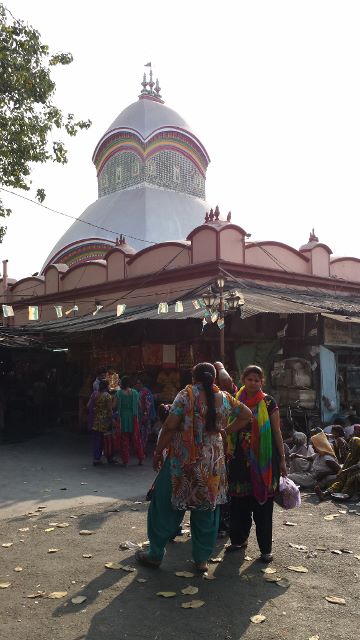
 Between my morning shift at Shanti Dan and my afternoon shift at “Kalinghat” (Mother Teresa’s original house for the “Destitute and Dying”), I visited Kolkata’s Kalinghat Temple. It is the only temple in India which Brahman still make animal sacrifices, 40 of which occurred on February 8. The Bhraman that showed me around the temple explained that goats are usually the chosen animals to sacrifice to the goddess Kali, though oxen and coconuts are sometimes also used. Though I was grateful for the friendly Brahman who took me through the temple, spoke prayers for my family, and told me when to take off and put back on my shoes, watching a goat die only reconfirmed my vegetarianism. It was not the best introduction to the religion for me, so I will seek out other ways of learning about it in the future. I have difficulty believing that a higher power created baby goats in order to have their heads chopped off in a small, marble room and their blood drained into a chalice as they squirm, but I’m sure there are many other things that happen for reasons I do not understand. The rest of the temple was a lot like my perception of India thus far: vibrant, passionate, fragrant and loud. I was especially taken by the “tree of fertility,” which is wrapped in ribbons by women and was adorned with carnations on the day of my visit.
Contrasting with the lavish temple, Mother Teresa’s original house for the “Destitute and Dying” is modest and dignified. Consistent with the Jesuit philosophy of Mother Teresa, the simple layout includes 45 female beds on one side of the building and 45 male beds on the other. The women range in social ability from completely non-verbal to speaking a few words of English. I don’t believe that any of them were non-communicative, but not being able to speak Hindi or Bengali really limited my ability to understand their desires and stories.
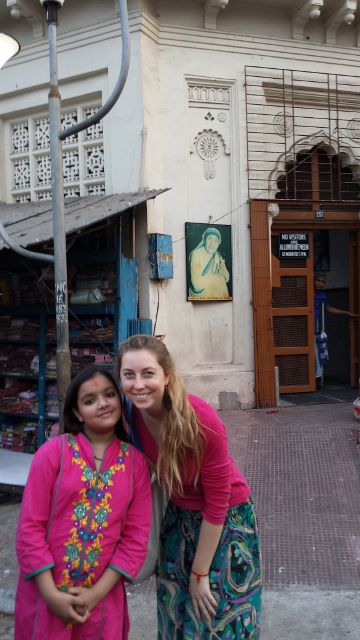
I entered the house each day armed with about a dozen pieces of scrap paper and a box of 10 colored pencils. I walked down the aisles of beds: “Hi, would you like someone to sit with you?” I knew they did not understand my words, but they were used to volunteers, so knew why I was there.
Far more than I’d imagined can be communicated through eye contact. This can only be understood in the absence of all other modes of communication. It was not the volume of information transferred, but the quality of communication that sustained my craving for discovery. The first lady I sat with looked deeply compassionate. She made it clear that she was not interested in using my pencils, but still wanted someone to sit with her and chat. She spoke to me in Hindi and I spoke in English. I told her about how I’d tripped earlier in the day, using running motions and drawing a picture of the bus I’d been chasing. She pressed her lips together and furrowed her brows, leaning in and touching my elbow and knee. I had not told her the sites of my bruises and broken skin (knee, hip and elbow), but her educated guesses were surprisingly accurate. Empathy guided her intuition.
I spent most of my short days at Kalinghat with two ladies in the back corner of the women’s room. One of them loved to color and interact. She looked young and full of life, but probably not of a full mental capacity. The other did not interact to steer the direction of the room, but watched our every move. She was a tiny, wizened old woman who hid under a headscarf and refused every offer of help made to her. She walked at an almost-45-degree angle to get to the toilet (without assistance) and tucked herself in before anyone else could even offer to help her. I smiled shyly at the four-foot-tall woman frequently, knowing that only her eyes would smile back. I wanted to know where her fierce strength came from.
The more openly-interactive, younger woman expressed an interested in coloring. Each day that I returned to the house, she smiled at me immediately, beckoning me to sit on her bed and draw with her. We communicated mostly though art.

The first drawing I made was a tree, which was slowly joined by a river, hills, mountains and sky. I used it to explain where I came from, telling her that there were many fewer people, noises and cars in my land. She asked me how to say each picture she pointed to in English and repeated the words back to me, laughing after each repetition. She taught me to count in Hindi, which she also laughed at.
 On my last day at the house, she drew a picture of what I perceived to be a vine (much like the vines she’d drawn on subsequent visits) with a black stalk and red, blue and purple leaves. She then told me a story I desperately wish I could understand. She painted her story with melodic, cascading intonations. One of the other volunteers who’d been eavesdropping (but also did not understand Hindi or Bengali) described it as “the story of her life.” About 30 minutes into her monologue, she began sobbing quietly. All I could do was mirror her expression, squeeze her hands, and rub her shoulders and back. I pointed to her drawing, which she smiled at weakly and kept on explaining. I would like to believe that the tiny, wizened lady understood. I’m confident that she could hold the tragedies of 100 other women and men if given the chance. I imagine she’d slap them on the back and command them to carry on as she had. Today, she only observed.
I stayed an extra hour at the house on my last day, leaving on the subway after dark and then asking a few of the other volunteers sit with her and listen in the days that were to come. I had opened the floodgates to an expression of tragedy, the cause which will forever remain unknown to me. I sat with the storyteller until she fell asleep, then caressed her hand and slipped the colored pencils and a clean sheet of paper under her pillow.