By Josiah Beharry, Graduate Student Researcher, Center for the Humanities, UC Merced
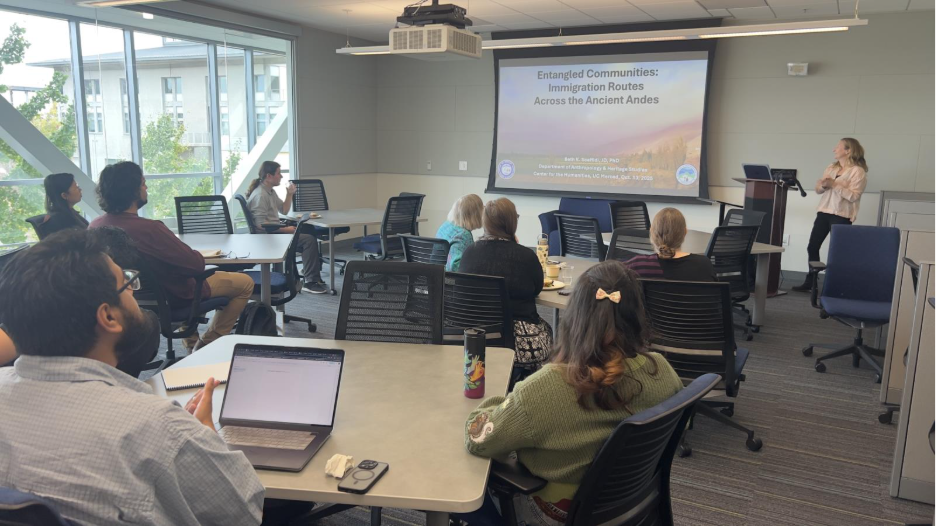
Dr. Beth Scaffidi, an assistant professor in the Department of Anthropology at UC Merced, doesn’t simply study the past. She tracks it, molecule by molecule, isotope by isotope, across thousands of miles and thousands of years. Her work uses geospatial data, isotopic analysis, and bio archaeological methods to reconstruct the lives of people who lived long before the idea of migration studies even existed.
“Every organism carries the geological imprint of where it comes from,” she explained. “Our bones are maps.”
That line lingered in the room. Because, for Scaffidi, these maps are not just scientific puzzles, they are stories. Each strontium isotope ratio etched into a tooth or bone tells a narrative of movement, a child born in one valley who dies in another, a community pushed by drought or empire, a family that followed the promise of fertile soil.
Her ongoing book project, a monumental synthesis of isotopic data across nearly a hundred archaeological sites in the Central Andes, seeks to redraw the migration routes of ancient civilizations. The goal is simple and powerful: to understand not just where people moved, but why – what social, environmental, and political forces shaped their journeys.
Mapping a Moving World
Scaffidi’s research traces the invisible borders of mobility; borders that, in her view, were far more porous than we imagine. By studying the chemical signatures locked within ancient skeletons, she identifies who was “local” and who was not. This method, she joked, is “the Cadillac of isotopic analysis,” capable of distinguishing even short-distance seasonal movement between highland and coastal communities.
Her data reveal intricate patterns. Waves of movement that aligned with trade, empire, and ecological change. During the Inca period, for example, entire populations were deliberately relocated, a form of state-engineered resettlement that both consolidated power and redistributed labor. But beyond imperial politics, Scaffidi’s findings complicate neat stories about identity.
“Mobility is not just about displacement,” she noted. “It’s also about connection […] about how communities absorbed newcomers, how knowledge and culture traveled alongside people.”
This humanistic thread runs through all of her work. Though grounded in hard science, Scaffidi approaches isotopic analysis as a way to illuminate the emotional and social worlds of the past. The bones, she insists, do not just record movement, they go further by recording meaning.
A Landscape Written in Stone and Skin
The Andes, with their geological diversity, are both a blessing and a challenge to this kind of research. The geology changes as quickly as the altitude, Scaffidi explained. A valley a few miles away might have a completely different isotopic signature. That complexity makes her work painstaking and exhilarating.
Her latest project began as an attempt to fill in the missing pieces of her synthesis, the unsampled regions, the overlooked sites, the untested eras. It became a journey of its own. Over the summer, she traveled across the Andes, visiting sites that once sat at the crossroads of ancient trade and migration. She photographed ruins, flew a UAV over sacred valleys, and collected images for a forthcoming digital appendix to her book. What emerged was a vivid understanding of how people navigated one of the world’s most formidable landscapes, a region where snow-capped peaks drop into rainforest, and desert plateaus meet ocean cliffs.
Seeing the Invisible
In the final part of her talk, Scaffidi turned to the question that animates her book’s last chapter: How do we recognize the non-locals of the past?
For centuries, archaeology has read migration through objects: pots, tools, architecture. Scaffidi asks us to look again at the art itself. In pottery, textiles, and wall paintings, she finds subtle signals of difference: the colors of headdresses, the lines of a tattoo, the angle of a figure’s jaw. They were documenting mobility in their own visual language, she finds. They knew the power of showing difference. These aesthetic traces, paired with the isotopic evidence, suggest that the Andes were not a world of isolated villages, but a web of exchange and adaptation. Migration was not an exception to ancient life; it was life.
The Book Still in Motion
Scaffidi admits the book remains in progress. The data keep expanding. The Andes, like the stories they contain, resist completion. But her presentation offered something richer than closure, a glimpse of a scholar unafraid to let her research breathe, evolve, and even detour. Fieldwork teaches humility: you go out looking for answers and come back with better questions. Scaffidi’s work offers a long view. A reminder that movement is neither new, nor unnatural. It is what binds us, in dust and in data, across the vast sweep of human history.