Tag Archives: museums

Public Humanities Boot Camp Features Methods and Best Practices from Across California

By Shiraz Noorani, Graduate Student Researcher, Center for the Humanities, UC Merced

A one-day Public Humanities Boot Camp was held in the Public Humanities Design Studio last spring, featuring seven speakers from across California who shared examples, methods, and best practices related to engaging communities.

Susan Derwin, the director of the Interdisciplinary Humanities Center and professor of German and comparative literature at UC Santa Barbara, launched the boot camp and shared several of UCSB’s public humanities projects, including, “The Making of Monuments.”
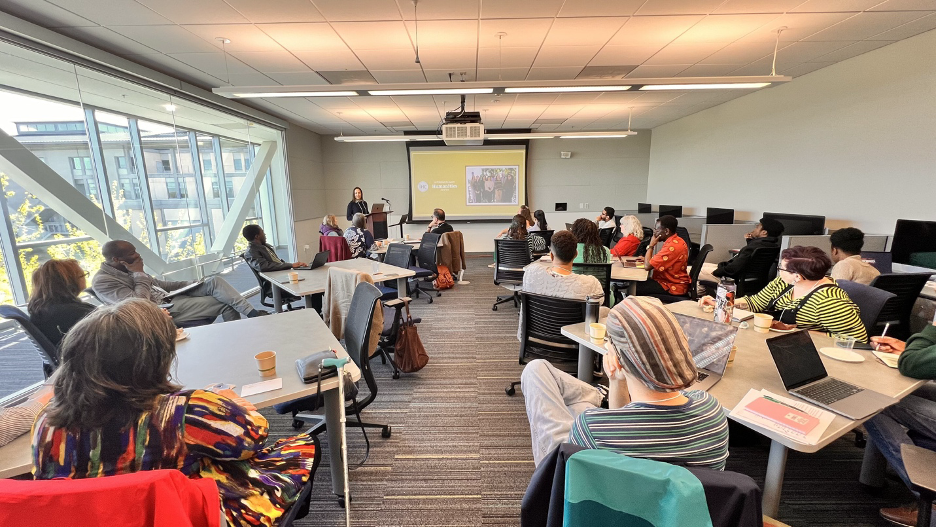
Professor Susan Derwin offering reflections on monuments and the role of humanities in society.

In her project, she works with teachers from the Santa Barbara Unified School District to develop lesson plans that introduce students to the significance of historical memory and their role as caretakers of those memories and the public narratives surrounding them. According to Derwin, doing public humanities does not only mean spreading knowledge but also working with communities and valuing their cultures.

Next, Rosemary A. Joyce, Emeritus Professor of Anthropology and a former museum director at UC Berkeley presented, “Exhibition Curation and Cultural Equity: Lessons from Teaching and Practice.” She explained how museums can represent various voices, narratives, and histories. She expressed that museums do not only portray different communities’ stories but also ask the communities for an active engagement in presenting their own stories. She emphasized respecting the historical narratives and cultural objects of different communities. 
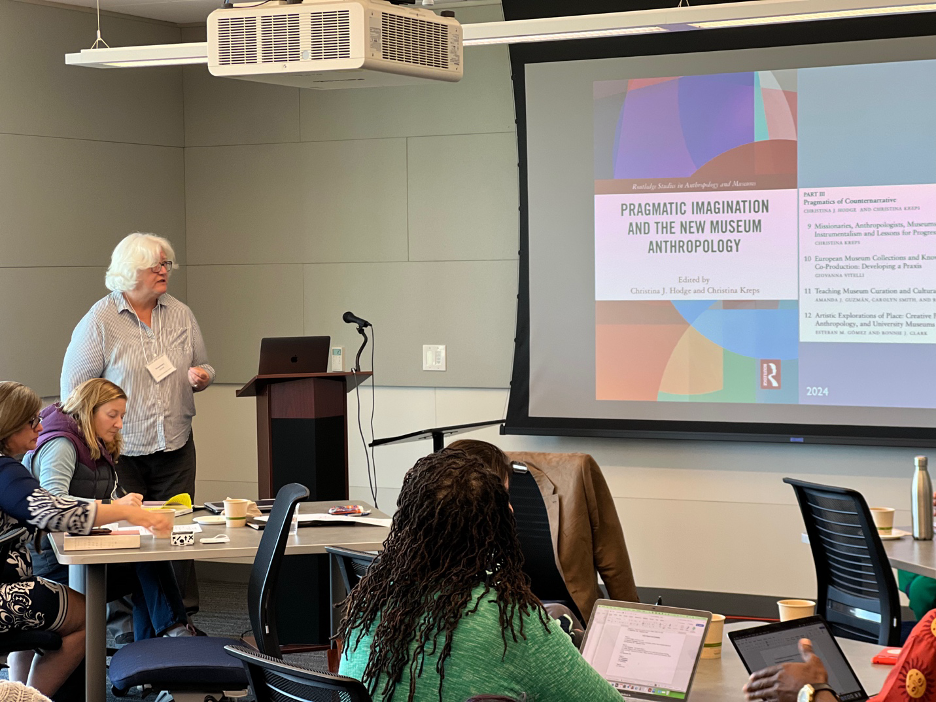
Rosemary A. Joyce highlighting the role of museums in amplifying community voices and fostering inclusive representation.

Rosemary emphasized the ethical responsibilities that museum exhibit curation and design should address. She said that a common mistake anthropologists make is speaking for communities rather than speaking with them, which leads to misrepresentation. She talked about the necessity for collaborative protocols that include community representatives in the decision-making process. She also stressed the need for flexibility in curatorial approaches, respect for culturally sensitive collections, and thoughtful consideration of language. She highlighted the issues of knowledge appropriation and the need to respect community-imposed restrictions on how cultural materials are displayed or interpreted.

Later in the day, Professors Benjamin D. Weber and Ofelia Ortiz Cuevas from UC Davis along with Assistant Professor Marlene Mercado from California State University, San Marcos, shared their project titled, “Beyond the Barriers and Open Letters from Prison.” In this project, the aim is to publish artwork and writing from four prisons in California. This project helps many people to be heard while they are behind bars, people who might have been silenced for years. This project was a good example of how public humanities can assist in healing open wounds and seeking justice.

Professors Weber, Cuevas, and Mercado present Open Letters from Prison.

Finally, Robin DeLugan, professor of Anthropology at UC Merced, presented a summary about the history of UC Merced and its collaborations with local communities highlighting our Carnegie Classification for Community-Engaged Research and our Luce Foundation Grant. She explained how community-engaged research projects have helped faculty, staff, and graduate students to be connected with local communities.  At the end of this session, Christina Lux, the managing director of the Center for the Humanities at UC Merced, talked about the differences and similarities between public humanities and community-engaged research. 

We ended the day by asking attendees to do a group activity, sharing their thoughts about public humanities and community-engaged research using a deck of “Public Scholar Conversation Cards” developed by Imagining America: Artists and Scholars in Public Life.

Boot Camp participants engage with the Public Scholar Conversation Cards during a group activity.

Public Humanities in Practice: Selected Annotated Case Studies

By Shiraz Noorani, Graduate Student Researcher, Center for the Humanities, UC Merced 

Crumme, Hannah Leah. “Building Community Archives: Vietnamese Portland.” The Routledge Companion to Public Humanities Scholarship. Routledge, 2024. 128-138.  https://www.taylorfrancis.com/chapters/edit/10.4324/9781003248125-10/building-community-archives-hannah-leah-crumm%C3%A9

In “Building Community Archives: Vietnamese Portland,” Hannah Leah Crumme describes an initiative of Lewis & Clark College’s Special Collections to broaden Portland, Oregon’s historical record by building a community-based digital archive regarding the Vietnamese American community. Recognizing that traditional archives are far too often centered on white settler histories, Crumme and her team wanted to document the diverse experiences that shape the city explicitly, especially those of Vietnamese immigrants and their descendants, in their contributions and struggles. It also represents an alarmingly underrepresented population in Portland. The project, launched in 2017, grew from the college’s initiative to create more inclusive collections to better represent Portland’s multicultural legacy. It has collaborated with community leaders, like Thao Tu, who is president of the Vietnamese Community of Oregon, for cultural sensitivity and authenticity by collecting oral history, photographs, and documents; often, translators have been used to capture stories in both languages, English and Vietnamese. For the most part, it has been grant-funded by institutions, including the National Endowment for the Humanities, allowing Crumme and her team to hire student workers and cultural consultants, as well as reach out to local Vietnamese groups via events such as the annual Tet Festival. It is an initiative that not only looks to preserve the heritage of Vietnamese Portlanders but also works to incorporate their stories into local education through materials for public school curricula and exhibitions in community spaces, broadening public understanding of the city’s historical landscape. 

Garcia-Medina, William. Making Black Public Humanities in South Florida: Fugitive Pedagogies, Self-Making, and Memory Work. Diss. University of Kansas, 2022. https://www.proquest.com/docview/2679773033?pq-origsite=gscholar&fromopenview=true&sourcetype=Dissertations%20&%20Theses

This dissertation by William Garcia-Medina gives a descriptive framework to understand the intersections of memory work with Black public humanities. He introduces theoretical methods underpinning the study of Black public humanities, including: fugitive pedagogy, a term that describes the educational practices Black educators have utilized to resist systemic oppression; and self-making, a concept that highlights the active ways in which Black individuals and communities shape their identities through cultural, intellectual, and political practices. These strategies are used in Black memory work, in the conservation and distribution of Black collective memory, and in making sure that histories are recorded and passed on through community-led initiatives.

Additionally, the dissertation discusses modern forms of public humanities within digital landscapes, demonstrating how the AARLCC embraces technology to expand its reach. It inspires further investigation into the ways digital platforms can magnify Black voices while staying rooted in local, community-based memory work. 

Hill, Cecily Erin, and Mariel Aquino. “Community Case Studies: How the Humanities Enrich Community Life.” National Humanities Alliance. https://nhalliance.org/wp-content/uploads/2024/05/NHA-COMMUNITY-CASE-STUDIES-OVERVIEW-2024.pdf

This document provides an in-depth exploration of how communities across the United States are utilizing the humanities to address societal challenges, preserve cultural heritage, and foster social equity. It showcases case studies from Nogales, Arizona; Rapid City, South Dakota; and Charleston, South Carolina, each illustrating how humanities-based initiatives are empowering local populations. Through partnerships with local organizations, these initiatives utilize history, storytelling, and cultural practices to address issues such as economic inequality, racial divisions, and environmental challenges. 

In Nogales, history and storytelling are used to reshape the narrative surrounding life on the U.S.-Mexico border, fostering a sense of pride and community resilience. In Rapid City, efforts focus on bridging divides between Native and non-Native populations through cultural recognition and historical research, leading to improved community trust and mental health outcomes. Charleston’s case study highlights initiatives aimed at confronting its legacy of slavery while promoting dialogue around the impacts of gentrification and climate change on African American communities. Together, these studies emphasize the vital role the humanities play in community-building and social progress. 

Ramirez, Mario H., and Lorena Gauthereau. “Documenting Transborder Latinidades.” The International Journal of Information, Diversity, and Inclusion 6.4 (2022): 1-7. https://www.jstor.org/stable/pdf/48720302.pdf?refreqid=fastly-default%3A83b2d3271332df2053e846c62e909d08&ab_segments=&initiator=&acceptTC=1   

The article “Documenting Transborder Latinidades” by Mario H. Ramirez and Lorena Gauthereau explores the dynamic relationship of archives, libraries, and digital humanities in the documentation of the lived experience of transborder Latinx communities. The authors have shown a rich history and identities formed across migrating journeys and colonial legacy.

This article underlines how community-based archives preserve and celebrate diverse histories formed with and within Latinx communities. These projects, in turn, collaboratively create an active form of memory-building participation among the archivists, academics, and people in these communities. This provides access on a wider scale and, consequently, allows self-identity and contributions of marginalized groups to have their voices heard at global and local levels. 

Shang, Haoyi. Telling Our Own Stories: An Analysis of Asian American Community Museums in the U.S. Diss. University of Pennsylvania, 2023. https://repository.upenn.edu/entities/publication/11d7eaaf-693d-4b62-bd01-ec9a24cbf358. 

This dissertation explores the importance of community museums in showcasing the stories of American communities from a cultural standpoint. The paper also highlights efforts to address the historical oversight of Asian American contributions in mainstream U.S. heritage narratives through case studies of three institutions: the Portland Chinatown Museum, the Wing Luke Museum in Seattle, and the National Cambodian Heritage Museum & Killing Fields Memorial in Chicago. The study delves into the significance of community museums in bridging history with shared memory and effectively involving the public in cultural engagement activities. Haoyi Shang touches upon the roles of museums as historical interpreters that support and safeguard local identities. Additionally, the dissertation explores the origins of these museums and their community-centric method of organizing exhibits to showcase a variety of narratives.