Dr. Beth Scaffidi and the Science of Ancient Mobility

By Josiah Beharry, Graduate Student Researcher, Center for the Humanities, UC Merced 

Dr. Beth Scaffidi, an assistant professor in the Department of Anthropology at UC Merced, doesn’t simply study the past. She tracks it, molecule by molecule, isotope by isotope, across thousands of miles and thousands of years. Her work uses geospatial data, isotopic analysis, and bio archaeological methods to reconstruct the lives of people who lived long before the idea of migration studies even existed.  

“Every organism carries the geological imprint of where it comes from,” she explained. “Our bones are maps.”  

That line lingered in the room. Because, for Scaffidi, these maps are not just scientific puzzles, they are stories. Each strontium isotope ratio etched into a tooth or bone tells a narrative of movement, a child born in one valley who dies in another, a community pushed by drought or empire, a family that followed the promise of fertile soil.  

Her ongoing book project, a monumental synthesis of isotopic data across nearly a hundred archaeological sites in the Central Andes, seeks to redraw the migration routes of ancient civilizations. The goal is simple and powerful: to understand not just where people moved, but why – what social, environmental, and political forces shaped their journeys.  

Mapping a Moving World  

Scaffidi’s research traces the invisible borders of mobility; borders that, in her view, were far more porous than we imagine. By studying the chemical signatures locked within ancient skeletons, she identifies who was “local” and who was not. This method, she joked, is “the Cadillac of isotopic analysis,” capable of distinguishing even short-distance seasonal movement between highland and coastal communities.  

Her data reveal intricate patterns. Waves of movement that aligned with trade, empire, and ecological change. During the Inca period, for example, entire populations were deliberately relocated, a form of state-engineered resettlement that both consolidated power and redistributed labor. But beyond imperial politics, Scaffidi’s findings complicate neat stories about identity.   

“Mobility is not just about displacement,” she noted. “It’s also about connection […] about how communities absorbed newcomers, how knowledge and culture traveled alongside people.”  

This humanistic thread runs through all of her work. Though grounded in hard science, Scaffidi approaches isotopic analysis as a way to illuminate the emotional and social worlds of the past. The bones, she insists, do not just record movement, they go further by recording meaning.  

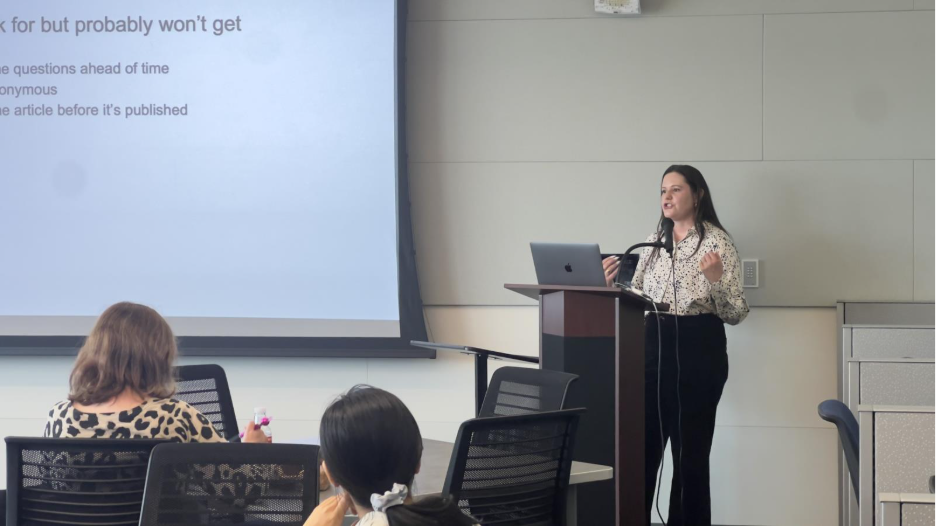
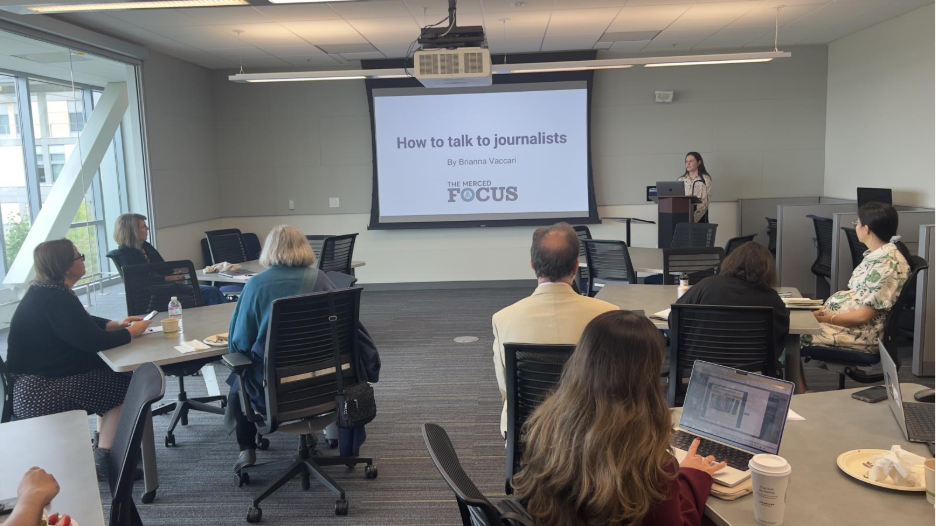
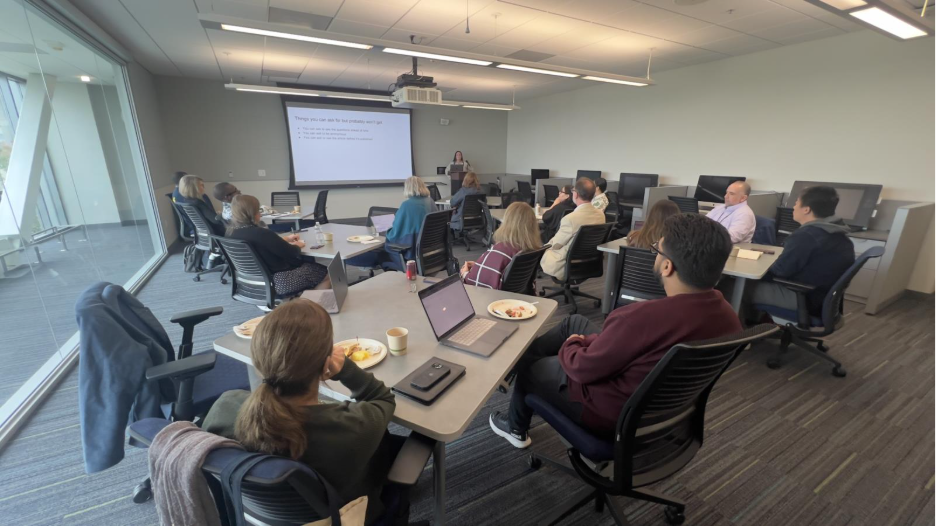
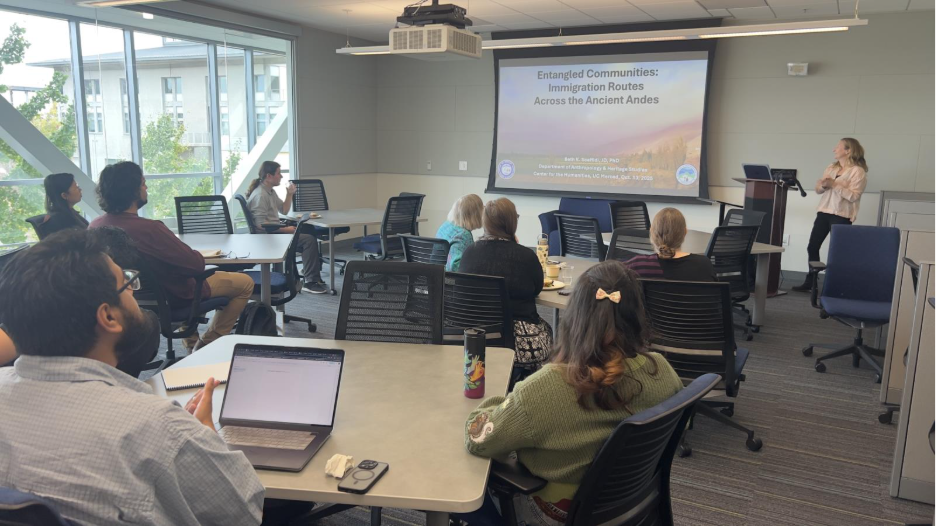
Dr. Beth Scaffidi speaks about her research on ancient mobility tracing human movement across the Andes through archaeological evidence.

A Landscape Written in Stone and Skin  

The Andes, with their geological diversity, are both a blessing and a challenge to this kind of research. The geology changes as quickly as the altitude, Scaffidi explained. A valley a few miles away might have a completely different isotopic signature. That complexity makes her work painstaking and exhilarating.  

Her latest project began as an attempt to fill in the missing pieces of her synthesis, the unsampled regions, the overlooked sites, the untested eras. It became a journey of its own. Over the summer, she traveled across the Andes, visiting sites that once sat at the crossroads of ancient trade and migration. She photographed ruins, flew a UAV over sacred valleys, and collected images for a forthcoming digital appendix to her book. What emerged was a vivid understanding of how people navigated one of the world’s most formidable landscapes, a region where snow-capped peaks drop into rainforest, and desert plateaus meet ocean cliffs.  

Seeing the Invisible  

In the final part of her talk, Scaffidi turned to the question that animates her book’s last chapter: How do we recognize the non-locals of the past?  

For centuries, archaeology has read migration through objects: pots, tools, architecture. Scaffidi asks us to look again at the art itself. In pottery, textiles, and wall paintings, she finds subtle signals of difference: the colors of headdresses, the lines of a tattoo, the angle of a figure’s jaw. They were documenting mobility in their own visual language, she finds. They knew the power of showing difference. These aesthetic traces, paired with the isotopic evidence, suggest that the Andes were not a world of isolated villages, but a web of exchange and adaptation. Migration was not an exception to ancient life; it was life.  

The Book Still in Motion  

Scaffidi admits the book remains in progress. The data keep expanding. The Andes, like the stories they contain, resist completion. But her presentation offered something richer than closure, a glimpse of a scholar unafraid to let her research breathe, evolve, and even detour. Fieldwork teaches humility:  you go out looking for answers and come back with better questions. Scaffidi’s work offers a long view. A reminder that movement is neither new, nor unnatural. It is what binds us, in dust and in data, across the vast sweep of human history.   

Joy as Resistance: What Rural Communities Can Teach Us About Survival

By Josiah Beharry, Graduate Student Researcher, Center for the Humanities, UC Merced

In times of loss and struggle, joy is often treated as an afterthought—something fleeting, maybe even indulgent. But what if joy is not a luxury at all? What if it is the very condition that allows communities to resist, endure, and imagine beyond the limits imposed on them? 

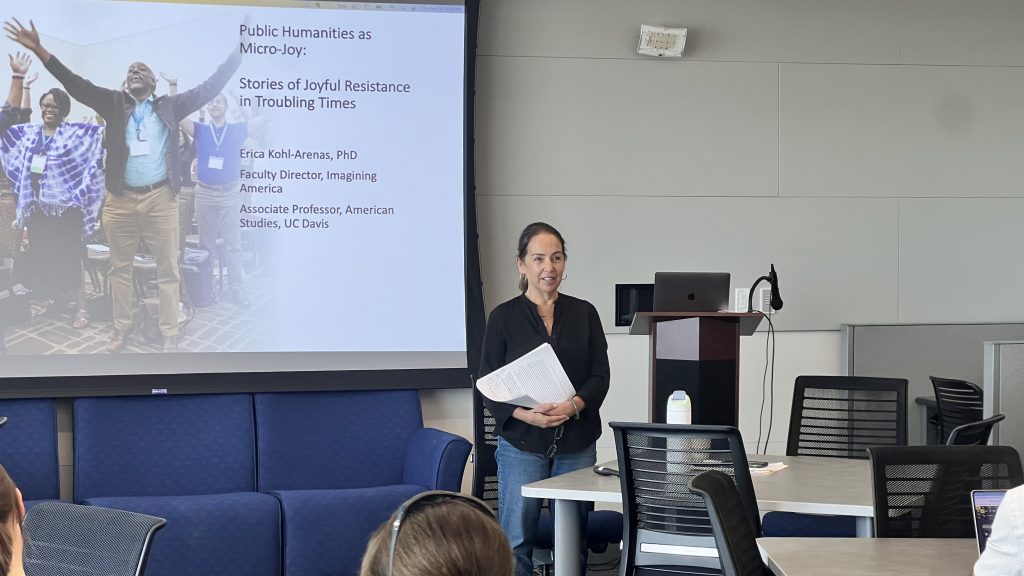
That question ran through Erica Kohl-Arenas’ presentation, Public Humanities as Micro Joy: Stories of Joyful Resistance in Troubling Times.” Her reflections—grounded in decades of collaborative work and long-standing partnerships with the Pan Valley Institute (PVI) in California’s Central Valley and the Mississippi Center for Cultural Production (Sipp Culture)—showed how joy lives at the center of community survival from California to Mississippi. 

Their shared projects—poetry slams in historic theaters, immigrant-led cultural festivals, and community farms reclaiming abandoned main streets—remind us that joy is more than happiness. It is not the shallow satisfaction of achievement or recognition. Joy is durable. It holds reverence, pride, connection, and grounding. It persists even alongside sorrow. 

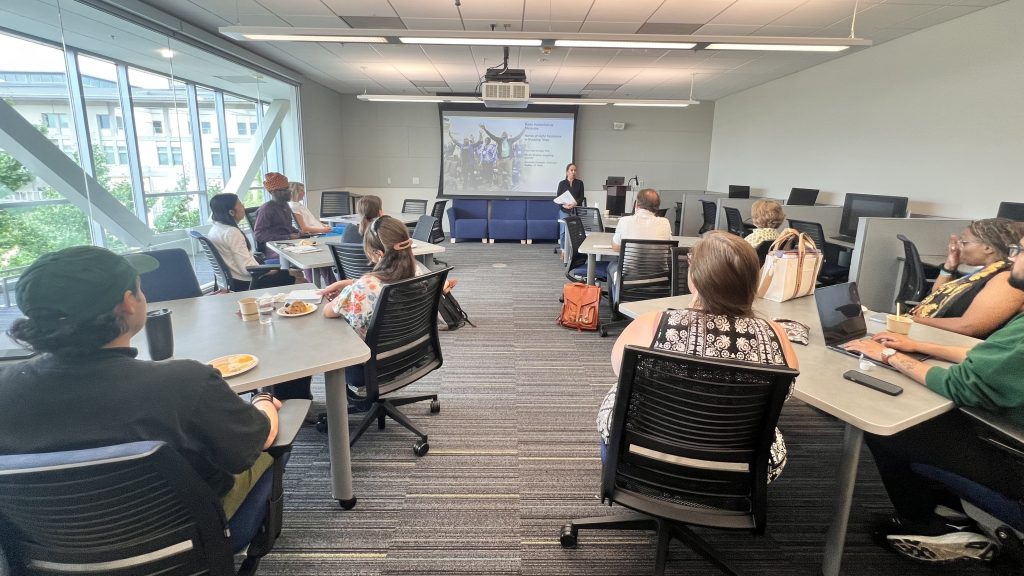
Erica Kohl-Arenas: joy as resistance, connection, and community.

The Fresh Poets of the Fillmore 

Three decades ago, in San Francisco’s Western Addition, a group of middle school students—labeled “troubled” by their teachers and dismissed by the city—decided to tell a different story. Guided by a youth organizer, they mapped the assets of their neighborhood: barber shops where homework got done, storefronts turned into classrooms, a bowling alley that doubled as sanctuary. 

Their work culminated in a dream that felt outlandish: to perform their own raps and poems on the legendary stage of the Fillmore Theater. Against all odds, the “Fresh Poets of the Fillmore” stood under the same lights that once held Billie Holiday and Jimi Hendrix. Their words brought parents, shopkeepers, and grandparents to their feet in ovation. 

This project, which predated Kohl-Arenas’ partnerships with PVI and Sipp Culture, was an early example of her own community-based organizing. It was more than a performance—it was a declaration: we exist, and we are worthy of celebration. 

Tamjavi: A Festival Against Fear 

Five years later and 200 miles south, Fresno’s immigrant and refugee communities were living under a different kind of shadow. After 9/11, immigration raids swept through the Central Valley, seeding fear and silence. Out of that climate, and through years of collaboration with community partners, the Pan Valley Institute (PVI) helped organize the Tamjavi Cultural Exchange Festival—a three-day takeover of Fresno’s Tower District that blended Cambodian opera, Oaxacan food traditions, Hmong comedy, Mexican bandas, and Indigenous storytelling. 

Over 3,000 people filled the streets. What could have been a moment of hiding became instead an act of public defiance and joy. The festival wasn’t just about art, it was about survival. About insisting that cultures too often marginalized or criminalized could claim space, laugh loudly, and be seen. 

Utica, Mississippi: Reclaiming Main Street 

Across the country in Utica, Mississippi, another story was unfolding. For decades, the town had been hollowed out: its textile factories gone, its grocery store shuttered, its high school closed. Yet the Mississippi Center for Cultural Production – known locally as SIPP Culturesaw something else. 

They asked residents to imagine their most beautiful food future. Elders wrote letters to future generations, describing town squares with cafés, gardens, and music. Teenagers interviewed their grandparents about recipes carried across generations. 

From that process, SIPP Culture began buying back the town’s abandoned main street. What was once a symbol of abandonment is now an industrial kitchen, a farmers’ market, a performance space, and a 17-acre community farm. Founder Carlton Turner calls it “taking the keys back from the Confederacy.” 

In Utica, joy looks like collard greens grown in backyard gardens, oral history circles with teenagers on the edge of their seats, and the smell of biscuits stamped with a grandmother’s three-finger brand. 

Joy as Public Humanities 

These stories matter because they challenge how we think about resistance. Too often, resistance is reduced to protest, policy, or opposition. But the Central Valley and Mississippi Delta remind us that resistance also looks like a story carried across oceans, a meal shared across cultures, a festival dancing with laughter in the face of fear. 

The Pan Valley Institute and SIPP Culture call this agri(cultural) justice: reclaiming land, food, and culture from the same systems that once dispossessed them. But their work also embodies something larger. They show that joy itself is infrastructure and a resource that sustains movements, binds communities, and makes survival not just possible, but beautiful. 

As Grace Lee Boggs once wrote, revolutions are not only about tearing down but also about creating. To create under conditions of scarcity, repression, or trauma requires more than strategy. It requires joy. 

Erica Kohl-Arenas shares how joy fuels communities into acts of resilience and celebration.

The Work Ahead 

Partnerships between academics and communities, between California and Mississippi, are not simple. They take decades of trust, humility, and showing up as full selves rather than institutional representatives. They require letting go of control and letting community wisdom lead. 

But the reward is immense: not only thriving festivals, gardens, and performances, but also the reawakening of imagination itself; because joy is not the opposite of struggle. Joy is what makes struggle bearable. Joy is the language of survival. And joy shared, celebrated, cultivated is what points us toward the futures we have yet to build.