
By Carlo Acevedo, Graduate Student Researcher, Center for the Humanities, UC Merced
On September 11, three weeks into the fall semester, a group of scholars from a wide range of disciplines in the humanities, social sciences, and STEM fields gathered at the UC Merced Center for the Humanities to discuss a key topic that is part of larger ongoing conversations in higher education: the place of Artificial Intelligence in and beyond the classroom. Our Center’s opening event, ‘Curriculum Design in the Age of AI’, featured guest speaker Dr. Goldberry Long, an associate professor of teaching in Creative Writing at The University of California, Riverside.
Shortly before 10:00 a. m., attendees started arriving. They were welcomed by two cardboard pitchers full of black coffee and hot water, respectively, and a varied offer of tea bags. Our center’s staff, organizing faculty, and our guest speaker were there, waiting for those who had registered. The space was very well lit by the sunlight coming through the glass wall that looks to the northwest end of our campus; the golden prairies, typical of the Central Valley, and the dim silhouette of the Sierra Nevada in the horizon.
To kick off the day-long program, Dr. Long gave a talk on ‘The Value & Use of Powerwriting’. She uses the term powerwriting to describe an innovative and creativity-enhancing process she designed for use in her classes. The result, as she shared her experience with the audience that day, has been a consistent engagement and creative exploration by undergraduate students, from all over the academic spectrum, in her general education creative writing courses.
Though this process originated in a creative writing environment, Dr. Long emphasized that powerwriting is a method adaptable to different assessment needs, disciplines, and genres.
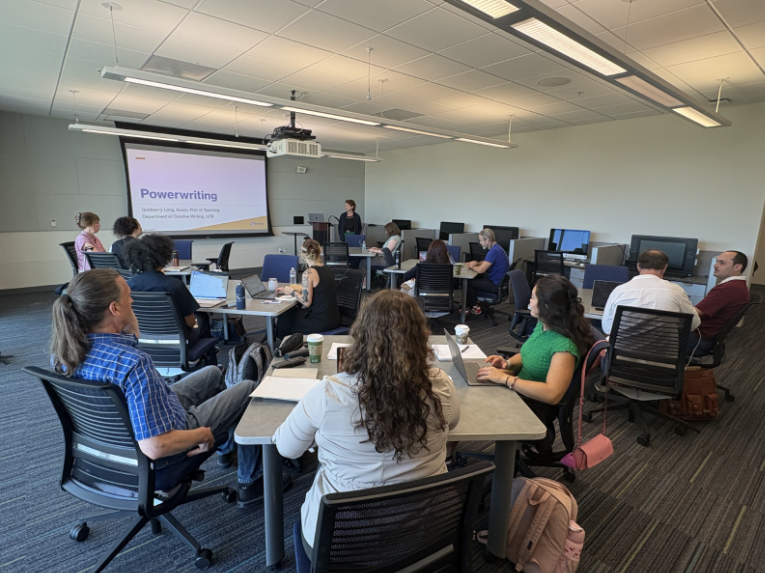
Powerwriting, as a method, is based on two pillars. On the one hand, the fact that writing is a complex cognitive process with different stages; on the other, the importance of letting students, through guidance, formulate the question or questions their text will answer. The presence of these two pillars permits the students to gain agency and autonomy, and it also regulates the process, which leads into scaffolding and approaching in a timely manner the main stages of writing: generating and revising.
In a metaphorical way, powerwriting is “thinking on paper”. This is justified by the fact that “creativity is messy”. Dr. Long made it clear that good ideas do happen, but they need to be written so they can be identified and developed. Inspired by very precise writing prompts, which are completed by the students themselves, powerwriting sets three parameters: 1) don’t stop writing, 2) risk, watch, refocus, and 3) type questions, type answers. In this way, students do the reflection, the analysis, the ideas and meaning generation, before technology can be introduced in the revising stage. Implicitly, this answers one of the first questions our guest speaker asked: “What can humans do with writing that AI can’t?”
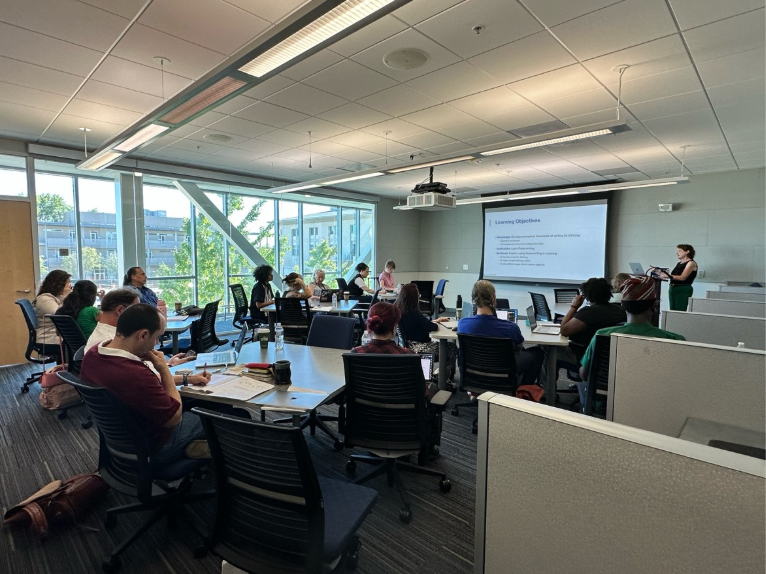
Ultimately, Dr. Long’s method also responds to a fundamental pedagogic dilemma: what are we asking/expecting from our students, and how are we as educators setting the ground so they can identify, generate, and organize information, and develop and manage the different tasks that complex processes suppose? Powerwriting sheds light on two crucial aspects: the importance of giving autonomy to students, so the task becomes engaging and relevant to them, and the necessity of making explicit, as educators, the processes that we have already mastered.
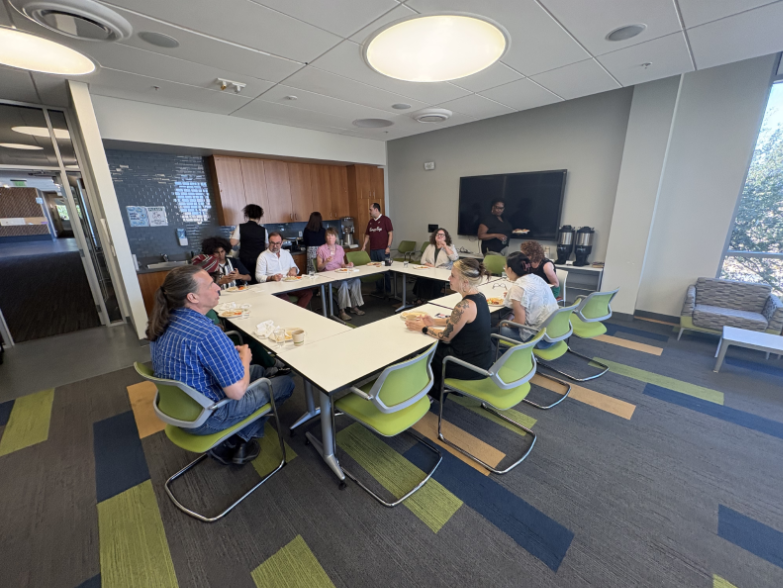
After introducing the principles of powerwriting, Dr. Long led a training session for the attendees. Dr. Long explained her method and then walked us through it so that we could experience what her students experience in class. At noon, the one-hour lunch break was an ideal opportunity for the attendees and our guest speaker to unwind, interact, and get an additional dose of caffeine to go through the upcoming work in the afternoon.
The afternoon program was divided into two sessions. From 1:00 to 2:30, Dr. Long guided a workshop and practice session: attendees were able to ask more specific questions, and Dr. Long shared a few samples of powerwriting done by students ranging from general education creative writing students to Medical School students. During the final afternoon session, from 2:30 to 4:30, the main group dispersed into smaller spontaneous groups as our guest speaker provided 1:1 consultations.
For all of those who were present and for anyone involved in education, it is obvious that writing, whether encountered in reading or generated through composition, is a foundational component of academic life. In terms of higher education, for example, undergraduate students need to familiarize themselves with the jargon and genres of their respective fields, and they are also expected to start producing texts that somehow interact with intellectual and disciplinary conversations.
In this context, what needs or blind spot does powerwriting address? The method Dr. Long created is a pedagogical response to the fact that, in the last few years, technology has facilitated the massive appearance of texts that never went through the human process of writing. Instead of playing catch me if you can with students who try to sneak generative AI text into their work, she decided to create an engaging and empowering process that enlists students in the creative process. Consequently, students end up deciding not to skip the initial and most relevant stages of writing. One of the first questions the speaker brought to the audience was “What can humans do with writing that AI can’t?” With this kind of apparently simple questions, the speaker’s objective was explicit from the beginning: “To break down our ideas of what writing is and what writing can do.” At the end of the day, participants left with a renewed sense of excitement about how to help their students understand just what human-powered writing can do.