By Carlo Acevedo, Graduate Student Researcher, Center for the Humanities, UC Merced
In the fall semester of 2026, UC Merced’s La Galeria has already resumed its commitment with strengthening the artistic scene in the Central Valley. Chicano Prints is the most recent exhibition on display. The opening reception was on October 14th and visitors will be able to enjoy it until December 5th. The fourteen pieces that constitute Chicano Prints are part of La Galeria’s permanent collection. Grace Garnica, UCM alumnus and gallery manager, curated the exhibition and made sure that it was varied and diverse in different ways. First, different printmaking techniques, such as lithograph and screenprint can be appreciated. Second, canonical artists in the Chicano tradition, like LA’s Patsi Valdez, share the walls with emergent creators like Treneley “Clover” Garcia. A visual cadence of political statements, cultural expressions, urban landscapes and rural labor colorfully guides the visitors from beginning to end. Garnica was kind enough to answer the following questions to let us know about her experience and intention preparing Chicano Print.
*The following Q and A is the result of a written interaction between Acevedo and Garnica.
First things first. For those who may not know, what is printmaking in the fine arts?
In formal terms, printmaking is an art form which transfers an image, usually made in ink, to a substrate, such as paper. Relief prints are made by carving the design out of a block of wood or linoleum. Screenprinting, or serigraphs, are made by pushing ink through gaps in a silk screen- this technique is also commonly used commercially for T-shirts. In general, printmaking has history dating back to ~200 BC and is an art form important to many cultures around the world.
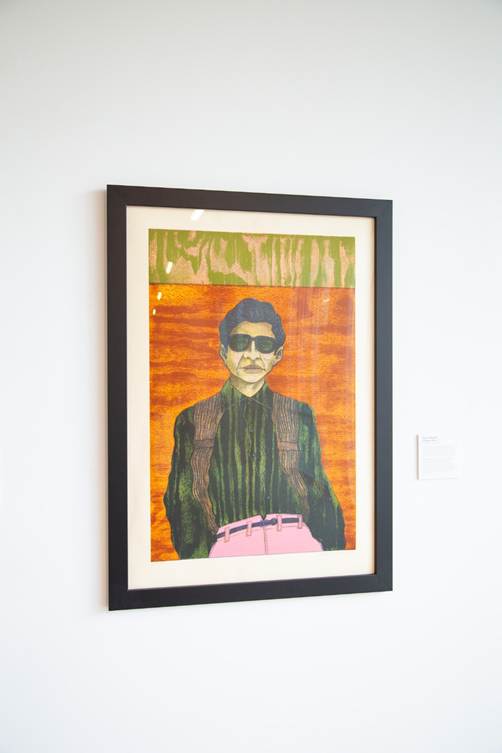
El pantalón rosa, by César A. Martinez. Piece chosen for the exhibition flyer. Picture taken by G. Garnica.
As you showed me a few days ago, La Galeria’s permanent collection, not all on display, has a wide variety of Chicano art, as well as other cultural expressions, like Hmong embroidering. What inspired the idea of putting together a Chicano print exhibition?
With over 80 artworks in our growing collection, it’s impossible to show them all together. We show selections on rotation every few years and it’s always enlightening finding new connections and shared themes in these artworks.
Over the past few years, we acquired 17 prints which had never been shown to the public, and thought it would be perfect to debut them alongside our pre-existing print collection. Together, I found that these prints showed a compelling history of Chicano printmaking both as a tool for activism and a vehicle for expressing identity. 13 of these new prints are from local artist Ruben A. Sanchez’s Harvesting Hands Across the Valley series, and I thought it was particularly meaningful to show Merced’s connection to the movement alongside early trailblazers like Patssi Valdez and Malaquías Montoya.
In this exhibition, you have very dramatic pieces, such as John Veladez’s Chicano Heaven (2013), and other ones that are very playful, like Patsi Valdez’s crisp Untitled (2019). Share with us some details about your journey selecting pieces, grouping artists, and organizing this visual voyage for your visitors.
Most of the time, my strategy when curating is to group artworks by theme or imagery and then connect each theme-group to tell a complete story. Of course, other elements always come in that change my original plans – the size of artworks, light sensitivity needs, or lack of space on a wall can mean re-arranging everything. I also try to consider color and how the artworks communicate to each other when placed together. The general groupings in this exhibition are music, activism, labor, and identity. Those two examples you chose are great because they’re right next to each other in the sort of Identity group. I liked how the warm colors in each piece complemented each other, but they also have that huge contrast in feeling which to me, demonstrates the variety in what identity can mean to Chicane artists.
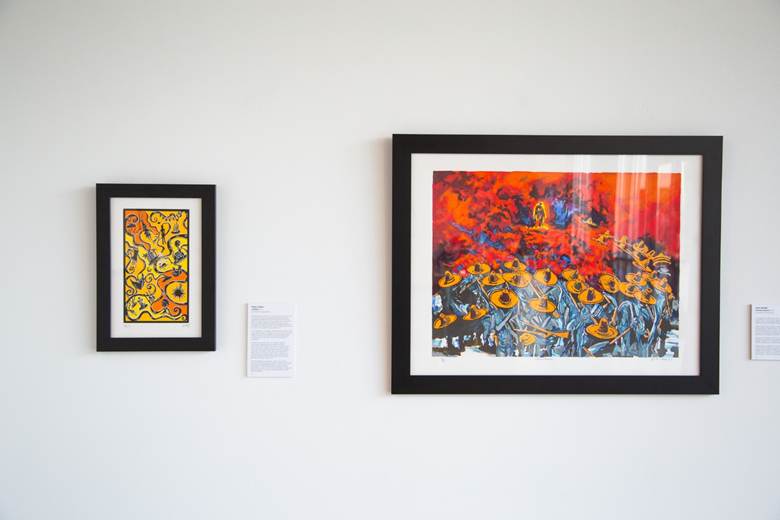
Left, Untitled, by Patsi Valdez. Right, Chicano Heaven, by John Veladez. Picture taken by G. Garnica.
For the exhibition’s flyer, you chose César A. Martinez’s El Pantalón Rosa (1992). The provocative male figure portrayed looks back at the viewer in a sassy way through a pair of translucent lenses. Why did you choose this intriguing piece for this purpose?
I enjoyed the bold colors and deceptively simple composition of this print; it was very eye catching. The figure’s confidence and style is a nod to Pachucos and reads as distinctly Chicano, but his sunglasses and detached gaze convey a sense of mystery and individuality. I feel that it speaks to the art movement’s focus on self-representation. As the artist César A. Martinez writes, “We had nothing to relate to, so we had to make it up as we went along. And that was the road to a deeper understanding of who we are.”
In my visit to La Galeria, I noticed that you keep a petite bookshelf with titles on Diego Rivera, Latinx art and art in California. Also, visitors can grab a handout that briefly explains, images included, different printmaking techniques. Why is this educational approach important for you?
It’s always important for me to have some tactile way to interact with an exhibition and engage with the material. In past exhibitions we’ve had entire interactive installations, but even if it’s just a mini library or a handout, I feel like it makes the content more accessible for different types of learners. The white walls, negative space, and strict (but valid) “do not touch” rules of a museum can make it an intimidating space. Sometimes a flyer to hold, or a chair to read in can make it a more welcoming experience for everyone.
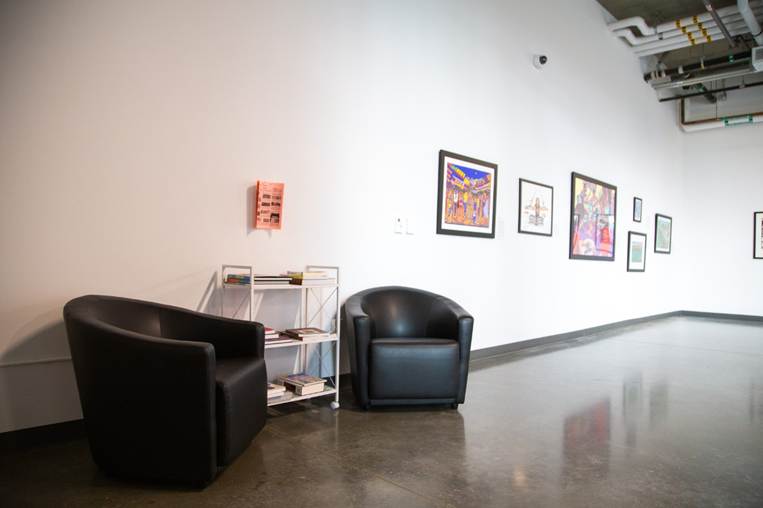
Lounge area, bookshelf and handouts station, and first pieces of the exhibition at La Galeria. Picture taken by G. Garnica.
The second piece of this exhibition is Sheila E., by Dominican artist Julia Santos Solomon. The Hispanic Caribbean or South America are not often included in the Chicano imaginary, so this is an unexpected move. How do you understand the Chicano tradition and how would you like to help shape it?
In my time working with Chicane art (and as a chicane artist myself), I have found it to be an ever-evolving movement. While the term is specifically tied to Mexican Americans, there are struggles and experiences shared by the Latine diaspora living in the United States which Chicane imagery and activism addresses. The UFW movement, from which Chicano activist printmaking gained popularity, was a multicultural movement that included Central and South Americans, Puerto Ricans, and Filipinos. This history should be acknowledged to tell a complete story of the movement. As I see it, ‘Chicane’ is a political and activist identity based in lived experience of duality and self-designation. Chicane art is about breaking boundaries imposed on us by society yet still, women and gender nonconforming artists have had to fight for their recognition in the movement. To me, the Latine / Hispanic diaspora in the United States are part of this ongoing history and should be recognized as such.
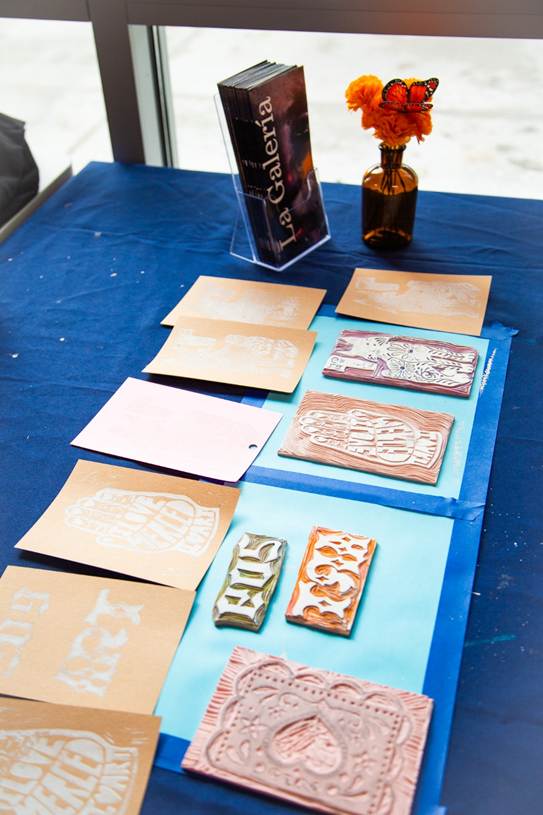
Station for the interactive printmaking activity at La Galeria. Picture taken by G. Garnica.
Are there any final thoughts you would like to share with our readers, to tempt them to come and check by themselves this sharp Chicano Print exhibition in La Galeria?
There are only a few weeks left to check out the exhibition! We also now have a printmaking lab in the gallery where you can create and take home your own relief prints so I hope you can come by and see it yourself!