Category Archives: Uncategorized

Public Humanities in Practice: Selected Annotated Case Studies

By Shiraz Noorani, Graduate Student Researcher, Center for the Humanities, UC Merced 

Crumme, Hannah Leah. “Building Community Archives: Vietnamese Portland.” The Routledge Companion to Public Humanities Scholarship. Routledge, 2024. 128-138.  https://www.taylorfrancis.com/chapters/edit/10.4324/9781003248125-10/building-community-archives-hannah-leah-crumm%C3%A9

In “Building Community Archives: Vietnamese Portland,” Hannah Leah Crumme describes an initiative of Lewis & Clark College’s Special Collections to broaden Portland, Oregon’s historical record by building a community-based digital archive regarding the Vietnamese American community. Recognizing that traditional archives are far too often centered on white settler histories, Crumme and her team wanted to document the diverse experiences that shape the city explicitly, especially those of Vietnamese immigrants and their descendants, in their contributions and struggles. It also represents an alarmingly underrepresented population in Portland. The project, launched in 2017, grew from the college’s initiative to create more inclusive collections to better represent Portland’s multicultural legacy. It has collaborated with community leaders, like Thao Tu, who is president of the Vietnamese Community of Oregon, for cultural sensitivity and authenticity by collecting oral history, photographs, and documents; often, translators have been used to capture stories in both languages, English and Vietnamese. For the most part, it has been grant-funded by institutions, including the National Endowment for the Humanities, allowing Crumme and her team to hire student workers and cultural consultants, as well as reach out to local Vietnamese groups via events such as the annual Tet Festival. It is an initiative that not only looks to preserve the heritage of Vietnamese Portlanders but also works to incorporate their stories into local education through materials for public school curricula and exhibitions in community spaces, broadening public understanding of the city’s historical landscape. 

Garcia-Medina, William. Making Black Public Humanities in South Florida: Fugitive Pedagogies, Self-Making, and Memory Work. Diss. University of Kansas, 2022. https://www.proquest.com/docview/2679773033?pq-origsite=gscholar&fromopenview=true&sourcetype=Dissertations%20&%20Theses

This dissertation by William Garcia-Medina gives a descriptive framework to understand the intersections of memory work with Black public humanities. He introduces theoretical methods underpinning the study of Black public humanities, including: fugitive pedagogy, a term that describes the educational practices Black educators have utilized to resist systemic oppression; and self-making, a concept that highlights the active ways in which Black individuals and communities shape their identities through cultural, intellectual, and political practices. These strategies are used in Black memory work, in the conservation and distribution of Black collective memory, and in making sure that histories are recorded and passed on through community-led initiatives.

Additionally, the dissertation discusses modern forms of public humanities within digital landscapes, demonstrating how the AARLCC embraces technology to expand its reach. It inspires further investigation into the ways digital platforms can magnify Black voices while staying rooted in local, community-based memory work. 

Hill, Cecily Erin, and Mariel Aquino. “Community Case Studies: How the Humanities Enrich Community Life.” National Humanities Alliance. https://nhalliance.org/wp-content/uploads/2024/05/NHA-COMMUNITY-CASE-STUDIES-OVERVIEW-2024.pdf

This document provides an in-depth exploration of how communities across the United States are utilizing the humanities to address societal challenges, preserve cultural heritage, and foster social equity. It showcases case studies from Nogales, Arizona; Rapid City, South Dakota; and Charleston, South Carolina, each illustrating how humanities-based initiatives are empowering local populations. Through partnerships with local organizations, these initiatives utilize history, storytelling, and cultural practices to address issues such as economic inequality, racial divisions, and environmental challenges. 

In Nogales, history and storytelling are used to reshape the narrative surrounding life on the U.S.-Mexico border, fostering a sense of pride and community resilience. In Rapid City, efforts focus on bridging divides between Native and non-Native populations through cultural recognition and historical research, leading to improved community trust and mental health outcomes. Charleston’s case study highlights initiatives aimed at confronting its legacy of slavery while promoting dialogue around the impacts of gentrification and climate change on African American communities. Together, these studies emphasize the vital role the humanities play in community-building and social progress. 

Ramirez, Mario H., and Lorena Gauthereau. “Documenting Transborder Latinidades.” The International Journal of Information, Diversity, and Inclusion 6.4 (2022): 1-7. https://www.jstor.org/stable/pdf/48720302.pdf?refreqid=fastly-default%3A83b2d3271332df2053e846c62e909d08&ab_segments=&initiator=&acceptTC=1   

The article “Documenting Transborder Latinidades” by Mario H. Ramirez and Lorena Gauthereau explores the dynamic relationship of archives, libraries, and digital humanities in the documentation of the lived experience of transborder Latinx communities. The authors have shown a rich history and identities formed across migrating journeys and colonial legacy.

This article underlines how community-based archives preserve and celebrate diverse histories formed with and within Latinx communities. These projects, in turn, collaboratively create an active form of memory-building participation among the archivists, academics, and people in these communities. This provides access on a wider scale and, consequently, allows self-identity and contributions of marginalized groups to have their voices heard at global and local levels. 

Shang, Haoyi. Telling Our Own Stories: An Analysis of Asian American Community Museums in the U.S. Diss. University of Pennsylvania, 2023. https://repository.upenn.edu/entities/publication/11d7eaaf-693d-4b62-bd01-ec9a24cbf358. 

This dissertation explores the importance of community museums in showcasing the stories of American communities from a cultural standpoint. The paper also highlights efforts to address the historical oversight of Asian American contributions in mainstream U.S. heritage narratives through case studies of three institutions: the Portland Chinatown Museum, the Wing Luke Museum in Seattle, and the National Cambodian Heritage Museum & Killing Fields Memorial in Chicago. The study delves into the significance of community museums in bridging history with shared memory and effectively involving the public in cultural engagement activities. Haoyi Shang touches upon the roles of museums as historical interpreters that support and safeguard local identities. Additionally, the dissertation explores the origins of these museums and their community-centric method of organizing exhibits to showcase a variety of narratives. 

Public Humanities: An Annotated Bibliography of Statements from Professional Associations and Organizations

By Shiraz Noorani, Graduate Student Researcher, Center for the Humanities, UC Merced 

This annotated bibliography is a compilation of guidelines and statements from various scholarly professional associations working in the field of Public Humanities. It was written with the aim to provide practitioners and scholars with a simple yet clear overview of how public humanities is practiced across disciplines. The sources annotated here delineate the ways that professional scholarly organizations engage communities through different initiatives. It also offers a foundation for understanding the role of public humanities in shaping more engaged, accessible, socially responsive academic work.     

“About the Field.” National Council on Public History, https://ncph.org/what-is-public-history/about-the-field/. Accessed 31 Oct. 2024. 

This webpage contains a comprehensive overview of public history, explains what public history is, and why it extends beyond academia. It explores how public history as a practice encompasses museums, archives, oral history, and historical consultancy. The source shows how public historians communicate with the public and share inclusive narratives. This is applicable to scholars who are involved in the process of outreach, collaboration, and public engagement in historical interpretation. More than that, this page indicates how public history can be part of community engagement and involvement; it introduces a set of guidance and training on how to be a Public Historian. The page also distinguishes between the understanding of public history and regular or traditional history and provides a robust definition of their distinctions.

Fisher, Daniel. “Goals of the Publicly Engaged Humanities.” Humanities for All. https://humanitiesforall.org/essays/goals-of-the-publicly-engaged-humanities. Accessed 17 Oct 2024. 

This document thoroughly explores the involvement of the public in humanities projects by delving into four real-life examples that highlight the collaborations between universities and local communities. These case studies from the Humanities for All database illustrate the advantages that arise from partnerships between institutions and different partners like K-12 schools and community organizations. They showcase activities such as safeguarding history records and developing educational materials while also fostering community leadership initiatives. This material is also useful for grasping how the humanities can forge ties between academia and the public domain as well as appreciating the role of such alliances in preserving culture and driving educational advancements.  

“For the Public.” Archaeological Institute of America, https://www.archaeological.org/programs/public/. Accessed 24 October 2024. 

“For the Public,” an initiative by the Archaeological Institute of America, demonstrates how archaeology is shared with the public through engaging activities, an element of public humanities practice. Their programs feature events like International Archaeology Day to encourage participation in activities and Interactive Digs that provide online access to real-time excavations. Moreover, the Site Preservation Program aims to protect archeological sites around the world by raising awareness, education, and outreach. With these programs, the American Archeological Institute not only fosters a deeper understanding of safeguarding future archeological heritage but also makes the past accessible to the public.

“Guidelines for Broadening the Definition of Historical Scholarship.” American Historical Association, 5 Jan. 2023, https://www.historians.org/resource/guidelines-for-broadening-the-definition-of-historical-scholarship/. Accessed 17 Oct. 2024. 

This American Historical Association document attempts to broaden the scope of scholarship, to include diverse forms other than books and articles, such as digital initiatives or a public history project, amongst others. It guides academics and organizations on how best to incorporate public humanities projects into their academic evaluations in the field of history. This page also offers a framework for reviewing traditional contributions by incorporating both examples of digital history and public history projects on different media platforms. It can thus be a helpful document for public historians and historians who are involved in public humanities projects in their attempts to correlate their work with established academic conventions. 

“Guidelines for Evaluating Publicly Engaged Humanities Scholarship in Language and Literature Programs.” Modern Language Association, August 2022. https://www.mla.org/content/download/187094/file/Guidelines-Evaluating-Public-Humanities.pdf.  

This document is a recommendation from the MLA’s Ad Hoc Committee for evaluating public humanities scholars in language and literature programs. The document emphasizes the ethical considerations in collaborating with communities, especially multilingual ones, and provides ways of evaluating projects that do not fit the conventional peer-review framework. The guidelines also explore the scope, impact, dissemination, collaboration, and deliverables of public humanities projects. 

This document also stresses the development of a system for rewarding faculty members for their work in the public humanities. It focuses on the effects of the projects on communities, the growth of the humanities, and the right approach to collaboration. It will be a significant and useful tool for institutions and departments looking to revise their faculty evaluation processes outside of conventional peer-reviewed publications. The guidelines also signify the need for diverse outputs of public humanities: podcasts, blogs, community reading groups, or exhibitions. It raises questions of ethics when working on community-based projects and suggests that the approach should be collaborative and non-extractive.  

Oliver, Younger. “Documenting the Impact of the Public Humanities in Higher Education: A Toolkit.” National Humanities Alliance, 2023. https://humanitiesforall.org/media/pages/resources/documenting-the-impact-of-the-public-humanities-in-higher-education-a-toolkit/58758ed5af-1689611837/impact-research-toolkit-final.pdf.

The toolkit offers a pathway to capturing the impacts of public humanities endeavors within higher education institutions. It describes helpful methods, including questionnaires, focus groups, and interviews, which can help practitioners understand the outcomes of their programs. In addition, it considers best practices in regard to ethics, inclusion, and the qualitative and quantitative data analysis that is critical for capturing program impacts related to public and community-based humanities work. The section on ethics and accessibility emphasizes the importance of protecting anonymity and advising on conducting research that respects participants’ backgrounds, as well as analyzing and using data one has collected to craft stories, showcasing the importance of public humanities work. 

“Public Education Programs.” American Anthropological Association, 9 June 2023, https://americananthro.org/learn-teach/public-education-programs/. Accessed 29 Oct. 2024.  

The American Anthropological Association’s webpage outlines its goals to promote public understanding of complex social issues through anthropological research. The webpage also emphasizes how these complex social issues are tackled through a multi-disciplinary approach, including science, history, and lived experience, in order to educate the public. Moreover, the AAA seeks to deal with social problems, including migration as well as racism, through projects like the RACE Project and World on the Move. These projects are funded by organizations like the Ford Foundation, the National Science Foundation, and the Wenner-Gren Foundation. This webpage aims to link scholarship and the public in a way that fosters a more profound and inclusive understanding of contemporary social problems.

“Public Engagement Programs.” American Academy of Religion, https://aarweb.org/AARMBR/Who-We-Are-/Public-Engagement-Programs.aspx. Accessed 17 Oct 2024. 

The webpage titled “Public Engagement Programs” outlines efforts by the American Academy of Religion to improve discussions about religion in the public sphere. The programs range from the American Lectures in the History of Religions, whose purpose is to stimulate scholarship in the history of religions, to the Public Scholars Project, which prepares scholars to be more effective public intellectuals in the study of religion. Other projects include the Religious Literacy Guidelines for College Graduates, which works to ensure religious literacy is integrated into undergraduate education, and the Guidelines for Teaching about Religions in K-12 Public Schools, which gives strategies for teaching religion in a constitutional and educationally sound way. The paper also acknowledges religious pluralism and public service by training chaplains through the Chaplaincy Program in order to accommodate religions in areas such as prisons and the military.  

It also covers the efforts towards combating Islamophobia by using a three-year project that trains educators on how to handle this kind of bias within classrooms. AAR/Luce Fellowships in Religion and International Affairs bring into view how religious scholarship is put into practice within secular government agencies to develop policies related to public health, human rights, and foreign affairs. The Levantine Refugee Project offers AAR members an opportunity to serve displaced Syrian and Iraqi populations, thereby humanizing the refugee crisis in the U.S. and bringing attention to the religious dimensions of that crisis. These efforts aim to link knowledge with discussions and policy decisions in the realm of religious studies for the benefit of public engagement and education. 

“Public Humanities Network.” Consortium of Humanities Centers and Institutes,  https://chcinetwork.org/networks/public-humanities-network. Accessed 29 Oct. 2024.  

This network intends to develop collaborations between academic institutions and civic communities. Topics they have included are defining “public humanities,” identifying the role of audiences, and establishing collaboration between academic institutions and the public. This network also shared its archive of recordings, which include videos like Conversation About the Black Studies Collaboratory; Public Humanities Mentoring Workshop; Public Humanities and Design Justice Workshop; Reckoning with Settler Colonialism and Imagining Just Futures Workshop; and How Do You Do Public Humanities? This network provides the necessary resources for both the scholar and the public to develop and implement robust and inclusive public humanities projects.

“Statement on Valuing Public Philosophy.” American Philosophical Association,  https://www.apaonline.org/page/publicphilosophy. Accessed 14 Oct. 2024.  

The American Philosophical Association, in this statement, explains its position on the value of philosophy and urges universities to acknowledge and appreciate philosophers who interact with non-academic people. The statement underscores the importance of philosophers getting involved in public discussions by linking ideas to real-world problems that may impact public policies. This statement emphasizes that public philosophy can take place in dialogue with other disciplines like humanities, arts, natural sciences, and social sciences. The APA also promotes the establishment of guidelines that acknowledge and adequately assess the impact of public philosophy on decisions regarding career advancement in academia. 

Wagner, Laura. “Taking Linguistics to the Public: An Outreach Guide.” Linguistic Society of America. https://www.lsadc.org/rc_files/12/Taking%20Linguistics%20to%20the%20Public_0.pdf. Accessed 16 Oct. 2024.

The Linguistic Society of America has created a guide to assist linguists in participating in public outreach endeavors by recommending engaging approaches such as partnering to host events with public institutions. For instance, mentoring programs with local high schools, collaborating with universities to organize a linguistics summer boot camp or hosting a booth at a university festival to reach audiences. The guide is significant for its focus on involving the community in raising awareness of linguistics in society. This document also provides strategies for effective public outreach, such as creating an engaged and trust-based space while working within a team. It also emphasizes understanding the background knowledge of the intended audience for public-facing events when choosing the type of activities or topics. 
The Door Is Open: Why Our Monday Writing GROUP Matters

By Josiah Beharry, Graduate Student Researcher, UC Merced Center for the Humanities

A quiet ritual at UC Merced’s Center for the Humanities turns writing from a private test of willpower into a shared practice of showing up. 

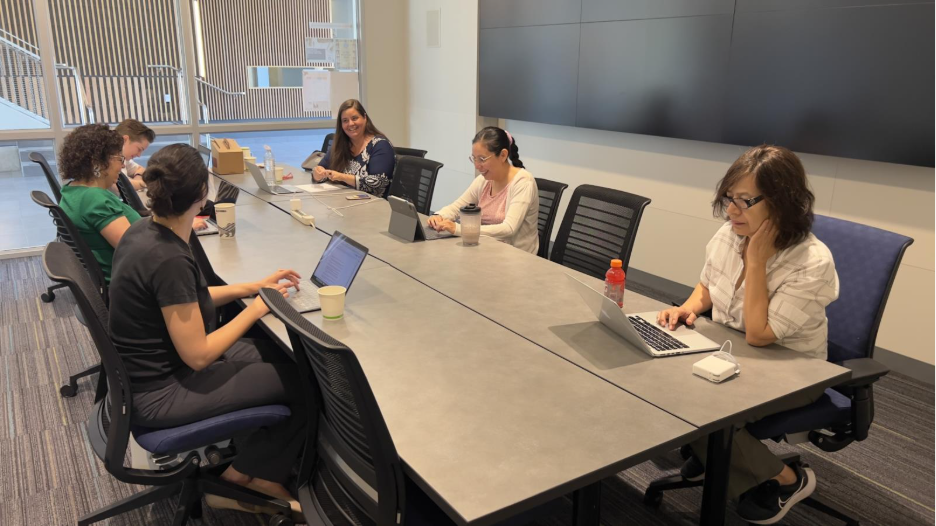
There’s a lie that floats through graduate school: writing is a solitary ordeal. You, your laptop, the blank page whispering, prove yourself. I don’t buy it, and it’s never worked for me! Scholarship is communal. It moves when we move together. That’s why every Monday, 9 a.m.–12 p.m., the Center for the Humanities opens a room and makes a simple promise: you won’t have to start alone. 

We don’t run a bootcamp with speeches and performances. Just a table, coffee, an outlet, a chair, and a culture of showing up. The room fills with scholars from every discipline—sharing a nod, parking the chaos at the door, and building an interdisciplinary calm around the one assignment we all share: writing (and grad school stress of course).  

Our Graduate Writing Group

Time Is the Real Barrier: Body Doubling, Minus the Hype
For many graduate students, the hardest part of writing isn’t craft—it’s time. And time is never neutral. If you’re teaching, caregiving, commuting, doing community work, or juggling jobs, the myth of the six-hour “ideal writing day” isn’t a strategy; it’s a mental prison—for anyone who can’t contort their life to fit it. Our room is the opposite: a low-barrier, three-hour block that respects life as it’s actually lived. You don’t need to clear your week to be a writer; you just need a door that opens  and fills with community. Call it co-working. Call it body doubling. The psychology is simple: when we work alongside others, the cost of beginning drops. The mind stops bargaining. The cue: quiet but firm, people here are writing—and your brain falls in line. No public check-in. No shame. Just the unglamorous mercy of co-presence. 

As someone with ADHD, body doubling isn’t a fad; it’s harm-reduction for attention. Clinicians and ADHD coaches note how co-presence lowers the “activation energy” to start and softens time-blindness and task-switching. I feel that in my bones. K–12 told me “good writing” meant sitting still, alone, and “just focusing”—a setup I routinely failed. Put me in a quiet room with other people working and the calculus changes. In this shared space the laundry/YouTube/TikTok spiral loses its grip; the shame soundtrack goes quiet; I borrow the room’s momentum. The accountability is gentle and external—no performance, just proof that starting is possible. For me, body doubling is the structure that makes showing up doable and staying put humane. 

The Schedule (and Why It Sticks) 

We draw, unabashedly, from Paul J. Silvia’s slim manifesto, How to Write a Lot. His premise is disarmingly simple: pages come from schedules, not inspiration. I agree and will  add this: schedules stick when they’re humane. Our room doesn’t tell you how many words to hit or which method to use. It gives you a recurring appointment and gets out of your way. Discipline, yes. Drills, no. 

How I Use the Room 

  • Arrive with one concrete task. Not “work on a chapter,” but “draft methods paragraph” or “clean up footnotes 8–12.” 
  • Draft messy on purpose. Brackets are my best friend: [check citation], [add quote], [figure out later]. 
  • Change the task, not the room. If I stall, I outline for ten minutes, then return to drafting. 
  • Leave a path back. I end by writing the first sentence I’ll tackle next time. 

None of this is required. It’s just how I make the most of a space designed to protect attention. 

Why It Works 

Humanities writing asks for depth. STEM writing asks for precision. Creative work asks for stamina. All three need uninterrupted stretches where attention can land and stay. That’s what this room provides. It lowers the temperature on productivity theater and raises the odds you’ll finish the paragraph you’ve been avoiding. 

And something else happens, harder to quantify: relief. The kind you feel in your shoulders. Relief that you didn’t postpone it again. Relief that you kept faith with your future self. Relief that the draft you feared is now a document you can actually revise. 

It works because the decision is already made. By the time Monday starts, you don’t have to negotiate with yourself: Will I write today? The answer is on the calendar. Week by week, your pipeline moves—drafts lift off the starting blocks, paragraphs find shape, and submissions leave your hard drive for someone else’s desk. 

Pages don’t pile up because we force them. They pile up because we return—to the same room, at the same time, with the same quiet intention. 

Mondays, 9 a.m.–12 p.m.: Center for the Humanities. The door is open. Bring your purpose and project. Stay for community and coffee. Leave with motivation and momentum. 

Tsia Xiong’s Advice for Sustaining Community Relationships

By Martin Ojeda, Staff Research Associate, “Stronger Together, Community-Engaged Research in the San Joaquin Valley” Luce Foundation Grant, UC Merced

This past fall, the Hlub Hmong Center Program Director, Tsia Xiong, came to UC Merced for the second time to give a workshop on building and sustaining relationships in community-engaged research. The purpose of the workshop was to train faculty members and graduate students on maintaining and growing relationships with community members.

Participants learned about four key steps to developing sustainable community relationships: maintaining, proposing, agitating, and celebrating/assessing. The workshop included hands-on activities such as a role-playing session and worksheets meant to track your intentions for developing relationships with community members. During the role play, participants partnered with others to find common interests and suggested roles they would like each other to fill based on their common interests. During the workshop, Tsia offered three main tips for navigating the four steps listed above.

Tsia Xiong, Hlub Project Director, speaking on celebrating and assessing outcomes with your community partner.

Tsia’s first tip for maintaining a relationship when conducting community-engaged research is having intentional one-on-one meetings. Tsia highlighted two key steps to consider before the meeting. The first is to reflect on the purpose of the meeting and what motivates you to meet with that person. The second is to list some actions and goals you want to reach. Knowing the purpose and the goal of the meeting is what makes the meeting intentional and clear to the person you are meeting with. Ultimately, one-on-ones show whether you and the other person can find a common goal and whether the person would be interested in investing their time with you.

The second tip that Tsia gave is that proposals need to be relational, meaning your partnership is built on mutual understanding and agreement. We create an effective proposal when we invite our partner to embrace a bigger role rather than simply assigning it. This can be accomplished by discussing why the new role matters, how someone’s skills can improve outcomes, and giving them space to reflect on how they feel and to provide feedback.

The third tip Tsia gave for the agitational phase is the need to be bold when assessing outcomes with your community partner. Tsia explained that the purpose of agitation is to raise awareness of shortcomings and give your community partner time to self-reflect. Boldness is necessary during this phase as the purpose of the conversation is to ask probing questions and recognize contradictions. Recognizing the gap between a set goal and realized results can be uncomfortable for both parties involved. Because of the risky nature of the agitational phase, Tsia emphasizes reiterating the importance of talents, and how the two of you can work together going forward.

The workshop underlined the importance of connecting and sustaining the relationship between researchers and community partners. Tsia equipped the audience with the tools required for effective relationship building and getting community partner buy-in. Overall, the tools given by Tsia can be helpful for developing an effective community-engaged relationship because they ensure mutually beneficial outcomes for both parties by having clear goals, mutual agreement, and honest conversations about outcomes.

Tips on Making Community Engagement Count

By Martin Ojeda, Staff Research Associate, “Stronger Together, Community-Engaged Research in the San Joaquin Valley” Luce Foundation Grant, UC Merced

Earlier this Spring, the Luce Initiative hosted a workshop with Anna Song, Associate Vice Provost for Academic Personnel, UC Merced and Iván González-Soto, UC Merced alumnus and Assistant Professor of Latinx History, WSU Vancouver. The workshop focused on strategies and tips for making community-engaged scholarship (CES) count towards faculty hiring and promotion. During the workshop, Anna and Iván were interviewed by Martin Ojeda about their experiences applying to faculty positions, best practices, and general advice for graduate students and new faculty.

Our first guest speaker, Iván, spoke from his experience as a former UC Merced graduate student and current junior professor at Washington State University. Iván spoke on how search committees in various types of teaching institutions look for people who can conduct interdisciplinary work and engage the public with their scholarship.

Iván’s focus was on how one can remain motivated over time. Key to sustained motivation was keeping a beginner’s mindset, applying to small grants, and being intentional with calendaring your time. Keeping a beginner’s mindset helps refresh your excitement for your given research topic. Additionally, applying to grants helps you gain more funding opportunities over time, creating a snowball effect. Iván related that keeping a scheduled calendar to apply for and write grants has been central to this process. Overall, Iván relayed that the passion behind your research, breadth of collaborations, and consistency of funding opportunities will be reflected in the CV that search committees will be looking at.

Anna Song and Robin DeLugan

Our second guest speaker, Anna, spoke from her experience as a tenured faculty member and senior administrator working in Academic Personnel. She spoke on how UC Merced decides on faculty promotion and tenure: tenure and promotion are decided by several review streams, such as academic senates, one’s academic department, and Dean. Anna’s advice to junior faculty was to learn how to communicate with multiple audiences. Effectively, this means that your research should be understood in the broader context of your field by those reviewing it, and as relevant and impactful.

Anna discussed the requirement to be productive for the purpose of tenure and promotion. Meeting this requirement can be difficult for community-engaged researchers, especially when balancing community and academic priorities. Academic productivity primarily needs to be framed in the context of your field and department. Anna suggests being productive in several ways: by organizing symposiums, leadership summits, writing methods papers, and publishing in areas such as open-access journals.

Ultimately, Iván and Anna converge in their advice as both spoke on the importance of effective research communication and productivity. They spoke of effective communication as a tool that is used in every aspect of your career, whether it is in collaboration with community members, other academic departments, or in gaining tenure. Secondly, both speakers emphasized the importance of being productive and how output builds up in one’s favor when applying to jobs or seeking promotion.

Tips for Effective Collaborative Writing

By Martin Ojeda, Staff Research Associate, “Stronger Together, Community-Engaged Research in the San Joaquin Valley” Luce Foundation Grant, UC Merced

Earlier this spring the Luce Initiative held a collaborative writing workshop led by Anne Zanzucchi, Associate Dean & Teaching Professor for Writing Studies. The goal of the workshop was to give guiding principles and examples on how to write effectively and in collaboration with other authors. The workshop covered writing myths, common group writing practices, and advice for effective collaborative writing. At the end of the workshop we heard reflections on collaborative writing from graduate authors Mariam Ohanlelham and Miriam Campos Martínez.

Collaborative Writing Workshop

The workshop introduced myths about writing, such as it being “a solitary activity” and “true expression being spontaneous.” These myths were contrasted with a quote from Octavia Butler on the dependability of habit-building over inspiration, as well as fun facts about collaborative writing. For example, in physics, it is common for there to be from 70-80 authors on a project with specific roles and functions.

Anne’s first piece of advice is: create an outline when developing group perspectives. Anne explains that team members should restate each other’s points in one or two sentences, develop outlines for team member contributions, and identify effective and ineffective areas of the group’s writing. Summarizing and outlining allows for a team to see a bigger picture.

The second piece of advice is: discuss findings before writing. Anne suggests that teams should consider meeting before they start writing, once they have gathered information. During this meeting each group member should report what information they found to the group as it may affect what another member writes about. Additionally, during this meeting, the group should evaluate the quality of the information reported on by other members.

Anne Zanzucchi

Following Anne’s presentation, Mariam and Miriam reflected on their experiences with collaborative writing. Mariam spoke on how having someone outside of her field reading her article helped clarify her writing and highlighted important sections that should be cut or expanded upon. Miriam recalled how helpful and motivating it was to have someone read and give feedback on her writing.

Merced Speaks: Exploring Language, Culture, and Community Through Signage

By Martin Ojeda, Staff Research Associate, “Stronger Together, Community-Engaged Research in the San Joaquin Valley” Luce Foundation Grant, UC Merced

In the fall of 2024, the exhibit “Merced Speaks: Language Diversity Past and Present” opened to a lively reception with UC Merced faculty, graduate students, and Merced community members at the Merced County Courthouse Museum. The exhibit included photographs of multilingual signage displaying various aspects of Merced life, from everyday restaurant signs to the Lao New Year Celebration.

The walls of the exhibit wove a rich tapestry of Merced’s diverse populations, languages, and cultures. The exhibit displayed how widely multilingual signage has been used in Merced, such as in cultural parades and the offering of multilingual services, including a banking sign written in Chinese from 1908 and flyers in Spanish posted at the Merced County Library. The exhibit presented a clear picture of how integral multilingual signage has been for immigrant communities in Merced.

Professor Robin DeLugan and Professor Patricia Vergara looking at the exhibit.

Much of the exhibit featured signs in front of local businesses advertising services like haircuts, car sales, and clothing alterations. The poster that caught my attention the most was titled “Navigating Housing, Health, and Food in Merced.” This poster included a Spanish sign for “Grupo Nueva Esperanza” or “New Hope Group” which is an AA group that specializes in supporting people with drug addiction, depression, isolation, and more. The second sign displayed on the poster included the signage written on the “People’s Fridge.” Written on the fridge door was “Toma lo que necesitas, deja lo que no” indicating people facing food insecurity in Merced are free to take what they need from the People’s Fridge.

The exhibit brought the signs to life and highlighted the importance of multilingual signage as a tool of engagement, support, and connection to other languages. Merced community members in attendance reflected on their childhoods in Merced and the broader San Joaquin Valley. One attendee spoke fondly of Merced’s downtown parades and the family tradition of riding on parade floats, now being passed on to their grandchildren.

Attending the exhibit was more than just an exploration of signs and language; it underscored the messages we share despite linguistic differences. The exhibit displayed how Merced communities have sustained their common histories over the years through the public display of signs that guide and support one another. Ultimately, the exhibit’s significance was illustrated by the stories, memories, and experiences conveyed by the community members in attendance.

The Quechua Manuscripts of the Yanacona Indigenous Leader and Poet Fredy Chikangana

Mabel Orjuela-Bowser, Ph.D. Candidate, Interdisciplinary Humanities, UC Merced

Fredy Chikangana generously gave me his original manuscripts of nineteen poems written in Quechua, some of which were recently on display at the UC Merced Library, together with more that I share here, accompanied by their Spanish version and my own or other English translations. While some of the poems are about the 2021 social outbreak in Colombia, others are about different topics. I was glad to find among them a few of his iconic poems such as “Quechua es mi corazón” (Quechua is my Heart) and “Espíritu de pájaro” (Bird Spirit).

Figure 1: Photo of the manuscript of the poem “Chunkay chunkayta,” from the author’s personal file

Chikangana, Fredy. “Chunkay chunkayta.” Copyright © 2021 Fredy Chikangana. Photo by Mabel Orjuela Bowser. Copyright © 2022 Mabel Orjuela Bowser. All rights reserved.

This is the original manuscript of the poem “Chunkay chunkayta” (Repeating Itself), written in Quechua Runa Shimi language. However, the words “(repitiéndose),” and “presidentes” are written in Spanish. In the first line, we can read “(repitiéndose),” in parentheses, which is the Spanish translation of the title “Chunkay chunkayta.” The use of the word “presidente” is probably because it does not have an equivalent in Quechua Runa Shimi language, as there is no such a figure in their culture. Some of the most common words to refer to a Quechua chief or chief communal authority are “kuraka” and “Pushak,” but they are not exactly equivalent to a Western president.

In “Chunkay chunkayta,” Chikangana establishes a genealogy of current power in Abya Yala (today known in Spanish as Las Américas) to show us that the invading civilization and its power have been repeating and adapting to the changes of the times, but without losing its true essence of domination in order to maintain its privileges.

The poem is unpublished, so there is no printed version in Spanish. With the author’s permission, I transcribe here the version that he read in Spanish at the Poesía en Resistencia event on May 28, 2021, followed by my own translation.

Figure 2: Photo of the poem “Repitiéndose”

Chikangana, Fredy. “Repitiéndose.” Copyright © 2021 Fredy Chikangana. All rights reserved. YouTube, uploaded by Festival Internacional de Poesía de Medellín, May 28, 2021, https://www.youtube.com/watch?v=c_4v9XmQFHc.

Figure 3: Photo of the poem “Repeating Itself”

Chikangana, Fredy. “Repitiéndose/Repeating Itself.” Copyright © 2021 Fredy Chikangana. English translation by Mabel Orjuela Bowser. Copyright © 2022 Mabel Orjuela Bowser. All rights reserved.

Figure 4: Photo of the manuscript of the poem “Chhusak,” from the author’s personal file

Chikangana, Fredy. “Chhusak.” Copyright © 2010 Fredy Chikangana. Photo by Mabel Orjuela Bowser. Copyright © 2022 Mabel Orjuela Bowser. All rights reserved.

Chikangana initially writes his poems in Quechua or Spanish, to later translate them into the other languages (Spanish or Quechua). Other times, he writes and translates at the same time, or writes in both languages simultaneously, implying that each version of the poem is an original creation, rather than a translation. This manuscript suggests that the poet translates, line by line, the poem into Quechua after it was originally laid out and written in Spanish in 1990.

This calligram expresses the feeling of emptiness experienced by the lyrical voice, the original peoples of Abya Yala, and all colonized subjects. The poem symbolizes the rupture of a world’s harmony due to the colonial experience.

Figure 5: Photo of the poem “Del Vacío”

Chikangana, Fredy. “Del vacío.” Samay Pisccok/Espiritu de pajaro, pozo del sueño. Ministerio de Cultura, Colombia, 2010, p. 65.

Figure 6: Photo of the poem “About the Emptiness”

Chikangana, Fredy. “Del vacío/About the Emptiness.” Copyright © 2010 Fredy Chikangana. English translation by Mabel Orjuela Bowser. Copyright © 2022 Mabel Orjuela Bowser. All rights reserved.

Figure 7: Photo of the manuscript of the poem “Samay Pisccok,” from the author’s personal file

Chikangana, Fredy. “Samay Pisccok.” Copyright © 2010 Fredy Chikangana. Photo by Mabel Orjuela Bowser. Copyright © 2022 Mabel Orjuela Bowser. All rights reserved.

In this original manuscript, the poem appears written in Quechua. However, the title “Espíritu de pájaro” and the penultimate line, “en pozos del ensueño,” are written in Spanish. This suggests not just a blend of words and grammar from two languages but a writing produced in a space where one feels, thinks, and writes in a kind of Spanchua (following the idea of Spanglish). The last line, in parentheses, seems to be the translation to Quechua Runa Shimi of the verse “en pozos del ensueño.” The author, in his own voice and that of his ancestors, sings joyous songs to the Pacha Mama (Mother Earth). He aspires with them to move the human heart for his community to preserve its Quechua roots while moving in a border space, to preserve the Andean spirit of the condor, and together weave a new era, an intercultural era.

Figure 8: Photo of the poem “Espíritu de pájaro”

Chikangana, Fredy. “Espíritu del pájaro.” Samay Pisccok/Espíritu de pájaro,  pozo del sueño. Ministerio de Cultura, Colombia, 2010, p. 19.

Figure 9: Photo of the poem “Bird Spirit”

Chikangana, Fredy. “Espíritu de pájaro/Bird Spirit.” Copyright © 2010 Fredy Chikangana. English translation by Mabel Orjuela Bowser. Copyright © 2022 Mabel Orjuela Bowser. All rights reserved.

Figure 10: Photo of the manuscript of the poem “Shimi machupay,” from the author’s personal file

Chikangana, Fredy. “Shimi machupay.” Copyright © 2010 Fredy Chikangana. Photo by Mabel Orjuela Bowser. Copyright © 2022 Mabel Orjuela Bowser. All rights reserved.

On this original manuscript, the poem appears written simultaneously in Quechua and Spanish. Each verse in Quechua is followed by its equivalent in Spanish. This technique appears in several of the poems in this collection.

“Shimi machupay” evokes the proverbial voices of the elders and ancestors, the local knowledge that is based on the wisdom of nature and of physical and spiritual living beings. The lyrical voice embraces mystery, opens hearts to listen to what Pacha Mama (Mother Earth) has to teach us, her advice, and her guidance for life.

Figure 11: Photo of the poem “Palabra de abuelo”

Chikangana, Fredy. “Palabra de abuelo.” Samay Pisccok/Espiritu de pajaro, pozo del sueño. Ministerio de Cultura, Colombia, 2010, p. 51.

Figure 12: Photo of the poem “A Word from Grandfather”

Figure 13: Photo of the manuscript of the poem “Takina,” from the author’s personal file

Chikangana, Fredy. “Takina.” Copyright © 2010 Fredy Chikangana. Photo by Mabel Orjuela Bowser. Copyright © 2022 Mabel Orjuela Bowser. All rights reserved.

This is the manuscript of a poem written in Quechua, without any translation. However, the Spanish version appears on the book Samay Pisccok  Pponccopi Mushcoypa / Espíritu de pájaro en pozos del ensueño (61). “Takina” is a poem built on a double staircase of images that descend from the left and from the right towards their center, to meet in “a poem.” Both staircases of images relate the woman to a poetic act. As a mother weaver of the community and as a woman in the private sphere.

Figure 14: Photo of the poem “Poema”

Chikangana, Fredy. “Poema.” Samay Pisccok/Espiritu de pajaro, pozo del sueño. Ministerio de Cultura, Colombia, 2010, p. 61.

Figure 15: Photo of the poem “Poem”

Chikangana, Fredy. “Poema/Poem.” Copyright © 2010 Fredy Chikangana. English translation by Mabel Orjuela Bowser. Copyright © 2022 Mabel Orjuela Bowser. All rights reserved.

Figure 16: Photo of the manuscript of the poem “Wiñay,” from the author’s personal file

Chikangana, Fredy. “Wiñay.” Copyright © 2010 Fredy Chikangana. Photo by Mabel Orjuela Bowser. Copyright © 2022 Mabel Orjuela Bowser. All rights reserved.

This poem gives us images of the Yanacona, a sensory people (“nose”, “mouth”, “eyes”, “ears”), who produce thought, knowledge, and wisdom in their communication with sacred nature (“tobacco and koka”). The harmony of their world was shaken by the invasion of Abya Yala and, in particular, by the invasion of the Andean worldview due to violence (“strangers”, “blood”, “death”) and the forced migration to the Western world. However, they retain their true roots.

Figure 17: Photo of the poem “Raíces”

Chikangana, Fredy. “Raíces.” Samay Pisccok/Espiritu de pajaro, pozo del sueño. Ministerio de Cultura, Colombia, 2010, p. 63.

Figure 18: Photo of the poem “Roots”

Chikangana, Fredy. “Raíces/Roots.” Copyright © 2010 Fredy Chikangana. English translation by Mabel Orjuela Bowser. Copyright © 2022 Mabel Orjuela Bowser. All rights reserved.

The Poetic Creation Process of the Oralitor Fredy Chikangana: To Feel, Think and Write in Quechua

by Mabel Orjuela-Bowser, Ph.D. Candidate in Interdisciplinary Humanities, UC Merced

Exhibit: To Feel, Think, and Write in Quechua

This past summer, I met with Fredy Chikangana, one of the most visible indigenous poets in Colombia. In an email exchange in 2021, Chikangana had promised to send me the original manuscripts of a series of poems written in Quechua, at the peak of the 2021 protests in Colombia. Our meeting allowed me to receive some of them personally. Once I had the manuscripts in my hands, I leafed through them trying to guess, from the cross-outs and notes, the process of creating these poems, wondering about the experience of writing them during the protests, and the reason why the author initially wrote them in Quechua.

For context, I want to explain more about who the poet in question is and what the protests in Colombia during 2021 were about. Then, in my next blog, with his permission, I will share several of his original manuscripts, some of which are currently on display at the UC Merced Library, through May 31, 2023. My exhibit The Poetic Creation Process of the Oralitor Fredy Chikangana: To Feel, Think and Write in Quechuahas two main goals:

1- To introduce the viewers to one of the most important contemporary indigenous poets from Colombia and Latin America. This is an invitation to learn about his trajectory as an indigenous leader and as an intellectual from the Yanakuna Mitmak community. Viewers also have the opportunity to learn about this culture from the Colombian Andes.            

2- To show viewers original manuscripts of poems written in Quechua Runa Shimi, a native language from the Colombian Andes, as well as printed copies of these poems in Spanish. The visual appearance of the printed version tells a story in a hegemonic language, while the Quechua manuscripts show us the author’s creative process and the importance of his mother language. This shows the viewers the process of feeling, thinking, and writing in his community’s mother tongue, as well as an idea of how the author crafted the bilingual final product.

The Indigenous Poet

Exhibit: To Feel, Think, and Write in Quechua

Fredy Chikangana is a poet and oralitor from the Quechua Yanakuna Mitmak culture. The poet defines himself as an oralitor to the extent that his writing is carried out alongside his sources: the orality of the elders. Yanakuna, from their own cosmovision (worldview), means “people who serve each other in times of darkness.” This community is located mainly in the southeast of Cauca, Colombia. His name in the Yanacuna community is Wiñay Mallki, which means “root that remains in time.” His poems have been published and translated into Italian, French, English, Romanian, and German in national and international magazines and newspapers, including Etnografist (Sweden), Kontakt (Denmark), Poetry Internacional (Holland), Casa de Poesía Silva (Colombia), and Antología de literatura indígena de América (Chile). His poems are part of the Biblioteca básica de los pueblos indígenas de Colombia (Basic Library of the Indigenous Peoples of Colombia), several anthologies of Colombian poetry, anthologies of indigenous poetry of the Americas, and are the subject of multiple literary reviews and postgraduate theses and dissertations. He has published several books, such as Kentipay llattantutamanta / El colibrí de la noche desnuda (The Hummingbird of the Naked Night) and Samay Pisccok pponccopi muschcoypa/ Espíritu de pájaro en pozos del ensueño (Bird Spirit in Dream Wells). Chikangana is also co-author of Herederos del canto circular (Heirs of the Circular Song) and Voces de Abya Yala (Voices of Abya Yala). Currently, he is working on a book about sacred medicine. Chikangana has been recognized and awarded nationally and internationally with prizes such as the “Humanidad y palabra” (Humanity and Word) poetry award from Universidad Nacional de Colombia (1993) and the Nosside Prize for Multilingual Global Poetry held in Italy (2019).

The Social Outbreak in Colombia

The protests of April 2021 against tax reform, with which the government of Iván Duque sought to raise taxes on the middle class during the COVID-19 pandemic, became an unprecedented mobilization in recent decades in Colombia. It was a true social outbreak where different demands repressed for decades, which go beyond economic demands, came together. In addition to demanding a more supportive state to deal with the economic damage caused by the pandemic and a reform of the police, the mothers of the disappeared, the indigenous, Afro-descendants, people of different sexualities, women, youth, the poor, peasants, and the unions were fighting for a different country, for an organic democracy. This would be a country built from below by the citizens, one that responds to a new political ethics, which includes, among many others, the defense of the environment and the development of peace. The indigenous communities in Colombia, including the Yanacona people, participated and protected the popular marches with their minga[1] methodology (an Inca tradition of community work) and the Guardia Indígena[2] (non-armed indigenous guard).

 As a result of this social uprising, there was an explosion of cultural expressions demonstrating social discontent about repression, as well as proposals for the construction of a country where we all could belong, where there is social justice and basic rights. Music, humor, caricatures, banners, literature, and many other manifestations flourished, capturing the facts and supporting the resistance. In this context, Chikangana accompanied the processes of resistance through the word, with which he illuminates another future for the protesters of the First Line[3] and all the racialized nations that co-exist in Colombia. As part of a border subjectivity, Chikangana writes these poems in Quechua and Spanish, two of the languages spoken in this territory of cultural diversity, to establish bridges of horizontal communication and reject the superiority of Spanish, the hegemonic language. With them, he reconstructs the origin and course of the current violence, which daily kills the hope of a country full of biological, cultural, and epistemic diversity. He expresses the hope of the peoples who resist and invites the construction of an organic, participatory democracy, built from below, which communalizes power.

The author is a poet, witness, and chronicler of the facts. Narrating from a situation of danger, he joins the marches and visits the different sites of resistance. Chikangana writes to the rebels in the heat of a historical rupture, of a social explosion that involves a new methodology (minga methodology). His poems represent an act of ownership of the protests, solidarity, fraternity, and accompaniment to the protesters. There is no waiting time for balsamic post-conflict poems.

Why Does the Author Write in Quechua?

On May 28, 2021, Chikangana presented some of these poems at the Poesía en Resistencia,[4] an event organized by Revista Prometeo. There, he explains that he begins his reading in Quechua to “remember the memory of our language present in our America, our Abya Yala.”[5] He needs to have the mother tongue of his ancestors present in order to keep the memory of their culture alive. Chikangana writes in Quechua Runa Shimi, the ancestral language of his community, because his poetry, although cosmopolitan and transnational, is rooted in his Yanakuna Mitmak culture. Keeping in mind the memory of his mother tongue is at the heart of his creative process.            

According to the National Indigenous Organization of Colombia, ONIC, in the country “70 languages are spoken: Spanish and 69 mother tongues. Among them, 65 are indigenous languages, 2 Creole languages (Palenquero of San Basilio and that of the islands of San Andrés and Providencia – Creole), the Romaní or Romaníes of the Roma people – Gypsy and the Colombian sign language.”[6] The Colombian law 1381 of 2010, in its second article, recognizes that native languages “constitute an integral part of the intangible cultural heritage of the peoples who speak them, […] The plurality and variety of languages is an outstanding expression of the cultural and ethnic diversity of Colombia…”[7] However, the reality is that in Colombia, like in most of the countries of Latin America, the official history has been written from the position of an ethnocentric power, with a Eurocentric vision that excludes other ways of being within our nation. The discourse and social practice of exclusion, as Foucault would say, leaves the original peoples out of the national project, and the official history relegates them to a category inferior to “civilized” Colombia. Therefore, speaking and writing in Quechua or any other indigenous language is a political act, an act of resistance against the disappearance of a culture. It is an attempt to preserve its memory inside and outside the local indigenous community. Keeping the ancestral language alive preserves the world it names and describes. In the creative process of the author, the language linked to the territory guides the writing and it gives the Pachamama[8] a voice. The possession of a pre-Columbian language from the Andes gives authority to the Yanakona peoples as an original culture of Abya Yala. Quechua, as their mother tongue, provides cohesion and authority by connecting them with the Inca Empire. The use of Quechua avoids epistemic privileges and brings together the diversities that inhabit Colombia to establish a horizontal dialogue between them.


[1] Minga comes from the Quechua word minka, which means collective work. The minga is a process open to intercultural dialogue.

[2] The Indigenous Guard is conceived as its own ancestral body and as an instrument of resistance, unity, and autonomy in defense of the territory and the life plan of the indigenous communities. It is not a police structure, but a humanitarian and civil resistance mechanism. https://commonspolis.org/en/proposals/security-according-to-the-indigenous-guard-in-colombia/  

[3] The First Line is a protesters’ defense group created two years ago in the anti-government protests in Colombia, against the government of Iván Duque. The main objective of the First Line was to repel the attacks and violence by the Mobile Anti-Riot Squad (Esmad).

[4] https://www.youtube.com/watch?v=c_4v9XmQFHc&t=48s

[5] Since 1977, the World Council of Indigenous Peoples agreed to use the pre-Columbian term “Abya Yala”, with which the Kuna culture refers to the territory that we know today as America. Abya Yala, in Kuna language, means “land in its full maturity” or “land of vital blood”. https://www.revistas.una.ac.cr/index.php/tdna/article/view/9712  

[6] https://www.onic.org.co/noticias/636-65-lenguas-nativas-de-las-69-en-colombia-son-indigenas

[7]https://www.funcionpublica.gov.co/eva/gestornormativo/norma.php?i=38741  

[8] Pachamama refers to the Mother Earth. “Pacha” in Aymara and Quechua means earth, world, universe. According to ancestral beliefs, Mother Earth takes the energy of the cosmos, the universe, time, and space. https://www.telesurtv.net/news/rituales-celebracion-dia-pachamama-20210801-0001.html