Tag Archives: community

Lessons on Public Philosophy from Andrew Fiala

By Shiraz Noorani, Graduate Student Researcher, Center for the Humanities, UC Merced

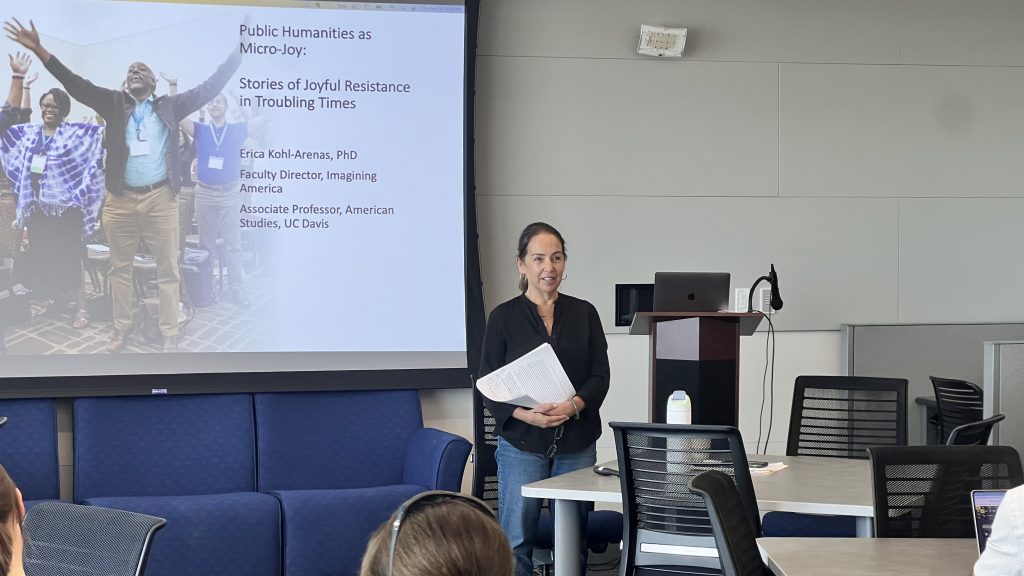
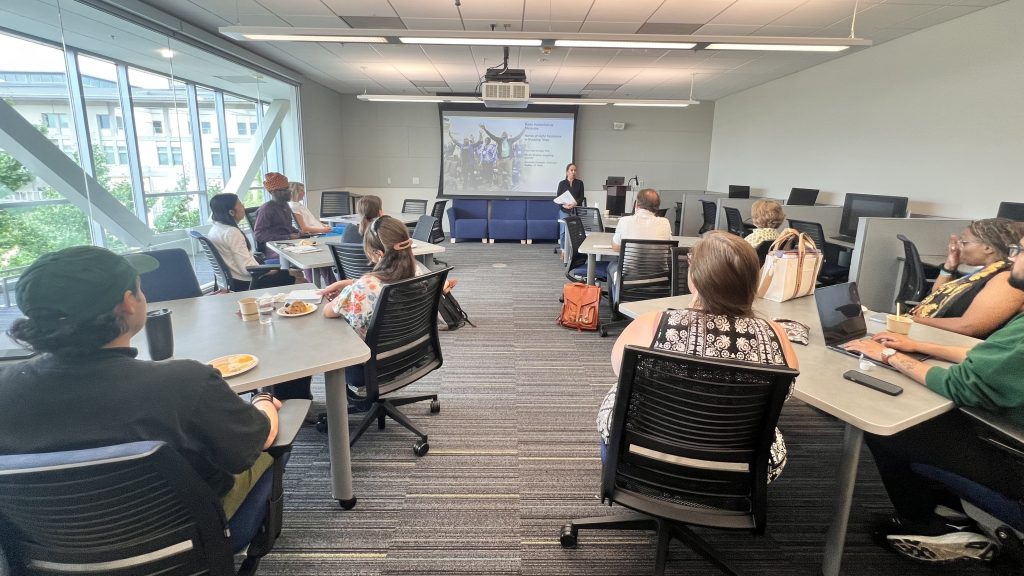
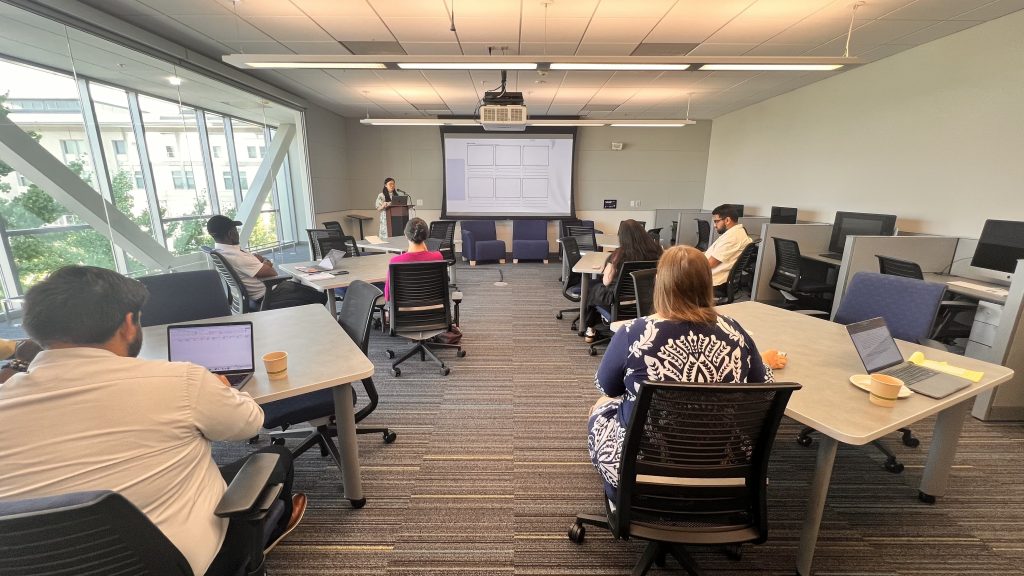
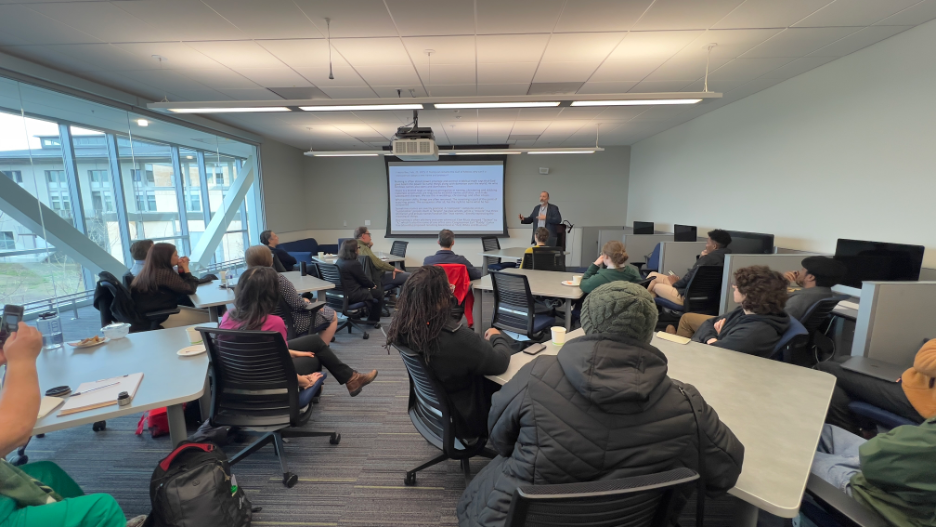
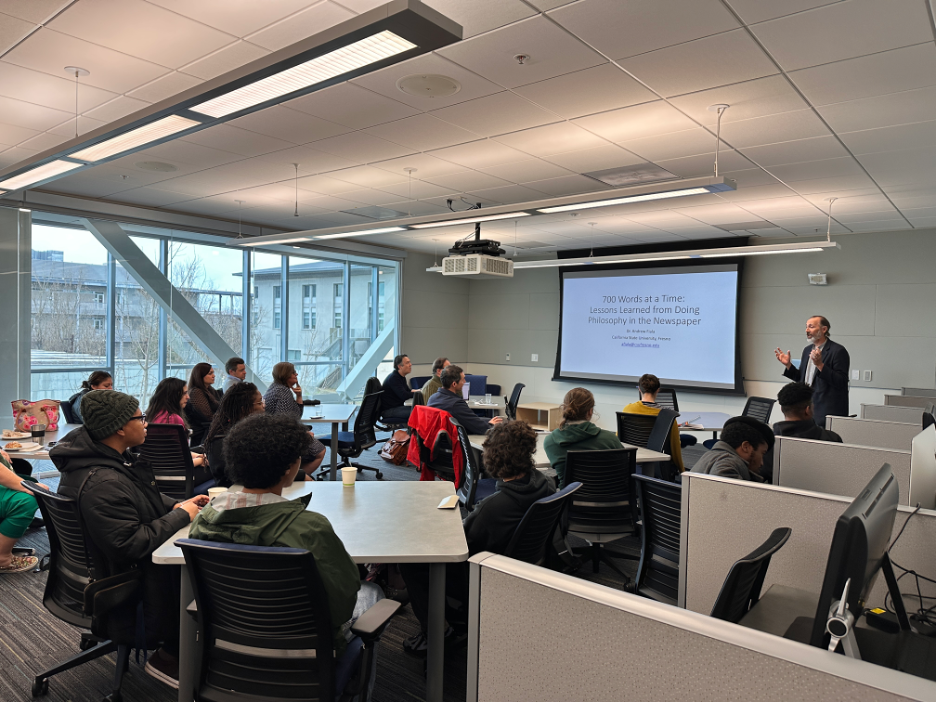
As part of our Public Humanities Speaker Series, Andrew Fiala, professor of philosophy and founding director of the Ethics Center at California State University, Fresno, gave his talk “700 Words at a Time: Lessons Learned from Doing Philosophy in the Newspaper, in our Public Humanities Design Studio at UC Merced last spring.

Professor Andrew Fiala Shares insights on public philosophy.

Professor Fiala has been practicing the art of public philosophy for many years. As a columnist with The Fresno Bee, he has written hundreds of columns on philosophy, ethics, and public discourse. His journey as a public philosopher has been motivating but challenging. Fiala’s talk was on how philosophy can be communicated to the masses through the media, via newspaper columns in particular. He spoke about how to condense and translate profound ethical and philosophical ideas into understandable columns that everyone can relate to.

Writing for a newspaper has helped Fiala learn to clarify complex ideas. He observed that public philosophy has to make people think and not react, and a good article should make people brainstorm, ask questions, and not just agree or disagree. He emphasized that the need for philosophical engagement is still strong, even as we move into a new era of technology. He feels that bringing philosophy to the public calls for passion, effort, and flexibility. Whether through blogs, newspapers, or social media, the task is to make philosophy applicable in everyday life.

Andrew Fiala reflects on making philosophy accessible through newspaper columns.

To illustrate the work of public philosophy further, Fiala gave some samples of his writings at The Fresno Bee, showing how he has dealt with ethical issues and philosophical questions in ways that ordinary readers can grasp, engaging with real world issues and promoting reflective conversation.

The talk was followed by a Q&A where Fiala discussed the challenge of moving philosophy into new media and emphasized the importance of keeping philosophical conversation relevant in a constantly changing world.

Public Humanities in Practice: Selected Annotated Case Studies

By Shiraz Noorani, Graduate Student Researcher, Center for the Humanities, UC Merced 

Crumme, Hannah Leah. “Building Community Archives: Vietnamese Portland.” The Routledge Companion to Public Humanities Scholarship. Routledge, 2024. 128-138.  https://www.taylorfrancis.com/chapters/edit/10.4324/9781003248125-10/building-community-archives-hannah-leah-crumm%C3%A9

In “Building Community Archives: Vietnamese Portland,” Hannah Leah Crumme describes an initiative of Lewis & Clark College’s Special Collections to broaden Portland, Oregon’s historical record by building a community-based digital archive regarding the Vietnamese American community. Recognizing that traditional archives are far too often centered on white settler histories, Crumme and her team wanted to document the diverse experiences that shape the city explicitly, especially those of Vietnamese immigrants and their descendants, in their contributions and struggles. It also represents an alarmingly underrepresented population in Portland. The project, launched in 2017, grew from the college’s initiative to create more inclusive collections to better represent Portland’s multicultural legacy. It has collaborated with community leaders, like Thao Tu, who is president of the Vietnamese Community of Oregon, for cultural sensitivity and authenticity by collecting oral history, photographs, and documents; often, translators have been used to capture stories in both languages, English and Vietnamese. For the most part, it has been grant-funded by institutions, including the National Endowment for the Humanities, allowing Crumme and her team to hire student workers and cultural consultants, as well as reach out to local Vietnamese groups via events such as the annual Tet Festival. It is an initiative that not only looks to preserve the heritage of Vietnamese Portlanders but also works to incorporate their stories into local education through materials for public school curricula and exhibitions in community spaces, broadening public understanding of the city’s historical landscape. 

Garcia-Medina, William. Making Black Public Humanities in South Florida: Fugitive Pedagogies, Self-Making, and Memory Work. Diss. University of Kansas, 2022. https://www.proquest.com/docview/2679773033?pq-origsite=gscholar&fromopenview=true&sourcetype=Dissertations%20&%20Theses

This dissertation by William Garcia-Medina gives a descriptive framework to understand the intersections of memory work with Black public humanities. He introduces theoretical methods underpinning the study of Black public humanities, including: fugitive pedagogy, a term that describes the educational practices Black educators have utilized to resist systemic oppression; and self-making, a concept that highlights the active ways in which Black individuals and communities shape their identities through cultural, intellectual, and political practices. These strategies are used in Black memory work, in the conservation and distribution of Black collective memory, and in making sure that histories are recorded and passed on through community-led initiatives.

Additionally, the dissertation discusses modern forms of public humanities within digital landscapes, demonstrating how the AARLCC embraces technology to expand its reach. It inspires further investigation into the ways digital platforms can magnify Black voices while staying rooted in local, community-based memory work. 

Hill, Cecily Erin, and Mariel Aquino. “Community Case Studies: How the Humanities Enrich Community Life.” National Humanities Alliance. https://nhalliance.org/wp-content/uploads/2024/05/NHA-COMMUNITY-CASE-STUDIES-OVERVIEW-2024.pdf

This document provides an in-depth exploration of how communities across the United States are utilizing the humanities to address societal challenges, preserve cultural heritage, and foster social equity. It showcases case studies from Nogales, Arizona; Rapid City, South Dakota; and Charleston, South Carolina, each illustrating how humanities-based initiatives are empowering local populations. Through partnerships with local organizations, these initiatives utilize history, storytelling, and cultural practices to address issues such as economic inequality, racial divisions, and environmental challenges. 

In Nogales, history and storytelling are used to reshape the narrative surrounding life on the U.S.-Mexico border, fostering a sense of pride and community resilience. In Rapid City, efforts focus on bridging divides between Native and non-Native populations through cultural recognition and historical research, leading to improved community trust and mental health outcomes. Charleston’s case study highlights initiatives aimed at confronting its legacy of slavery while promoting dialogue around the impacts of gentrification and climate change on African American communities. Together, these studies emphasize the vital role the humanities play in community-building and social progress. 

Ramirez, Mario H., and Lorena Gauthereau. “Documenting Transborder Latinidades.” The International Journal of Information, Diversity, and Inclusion 6.4 (2022): 1-7. https://www.jstor.org/stable/pdf/48720302.pdf?refreqid=fastly-default%3A83b2d3271332df2053e846c62e909d08&ab_segments=&initiator=&acceptTC=1   

The article “Documenting Transborder Latinidades” by Mario H. Ramirez and Lorena Gauthereau explores the dynamic relationship of archives, libraries, and digital humanities in the documentation of the lived experience of transborder Latinx communities. The authors have shown a rich history and identities formed across migrating journeys and colonial legacy.

This article underlines how community-based archives preserve and celebrate diverse histories formed with and within Latinx communities. These projects, in turn, collaboratively create an active form of memory-building participation among the archivists, academics, and people in these communities. This provides access on a wider scale and, consequently, allows self-identity and contributions of marginalized groups to have their voices heard at global and local levels. 

Shang, Haoyi. Telling Our Own Stories: An Analysis of Asian American Community Museums in the U.S. Diss. University of Pennsylvania, 2023. https://repository.upenn.edu/entities/publication/11d7eaaf-693d-4b62-bd01-ec9a24cbf358. 

This dissertation explores the importance of community museums in showcasing the stories of American communities from a cultural standpoint. The paper also highlights efforts to address the historical oversight of Asian American contributions in mainstream U.S. heritage narratives through case studies of three institutions: the Portland Chinatown Museum, the Wing Luke Museum in Seattle, and the National Cambodian Heritage Museum & Killing Fields Memorial in Chicago. The study delves into the significance of community museums in bridging history with shared memory and effectively involving the public in cultural engagement activities. Haoyi Shang touches upon the roles of museums as historical interpreters that support and safeguard local identities. Additionally, the dissertation explores the origins of these museums and their community-centric method of organizing exhibits to showcase a variety of narratives. 

Juntxs: How to learn from the communities of care that helped us survive the COVID-19 pandemic

By Alma Alvarado Cabrera, Interdisciplinary Humanities Graduate Student, and Semajay Cleaver, English Major at UC Merced

As a child, my mother would tell me stories of when, in her youth, she left her small village to work in the tomato fields in Sinaloa, Mexico. It was a short yet impactful time in her life. The stories that she would share with me are about how a group of older women took care of and mentored her. My mother profoundly cares about friendship and providing care for her children, godchildren, and anyone she encounters. Yet, she struggles with what we call self-care, among other things. 

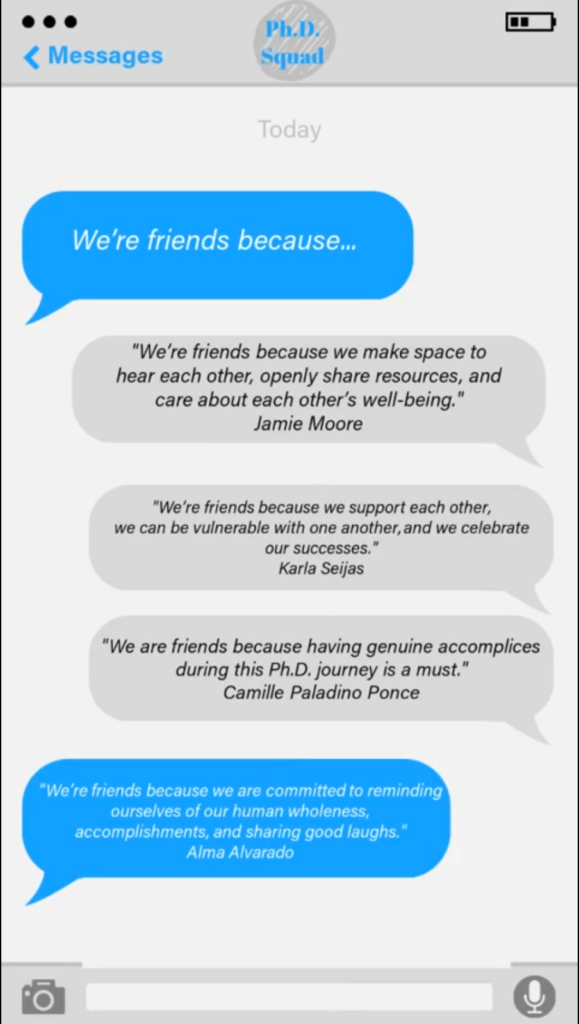
My mother gave me that first mode of care. Let us call this model the señora system: a group of women, usually older, sharing useful information, resources, and care among themselves and those they see mostly need it. After meeting Gloria Anzaldúa, Audre Lorde, and Toni Morrison through their writing, I expanded my mother’s model to include self-care, or as these authors redefined it, “self-preservation” and healing. This señora and poetic model of care has been helping me navigate graduate school and the COVID-19 pandemic. A daily manifestation of this model is a text message group called the “Ph.D. Squad,” which has been around since the Fall of 2019 and is composed of four beautiful, resilient, and caring women: Jamie, Camille, Karla, and me. 

Image created by Alma Alvarado Cabrera

Physically, we have not seen each other for almost one year yet are in constant communication through text messaging and social media. Our conversations touch on graduate school life but are not limited to our student or educator lives. Before and throughout the pandemic, we speak of our need to heal multiple personal traumas or academic-specific traumas like impostor syndrome. We remind each other of the importance of rest, setting boundaries, and eating dessert! As expected during our sociopolitical climates, we also vent and complain in the group. And memes are frequently shared! 

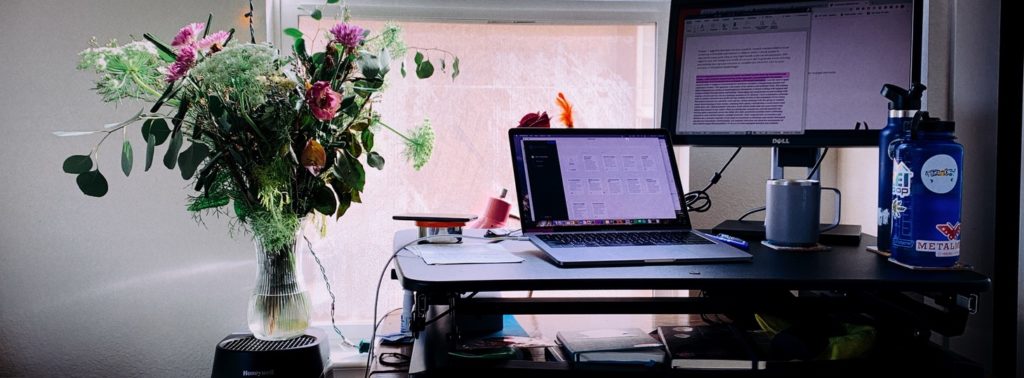
“Working in Isolation,” photo by Alma Alvarado Cabrera

When coping with physical isolation, the Ph.D. Squad is a reminder that we can be with each other. It is a reminder that we can practice listening, caring, healing, and grieving together without being in the same physical space. It is also a space that reminds us of what could be once we can be in the same physical places. It is an invitation to dream and imagine a classroom, offices, or community spaces where healthy communication and care continue to be centered. Shouldn’t care and healing always be a priority when working with underserved communities? 

I am inviting you to pay attention to the communities of care that help us cope with the challenges of the pandemics we experience. What makes them communities of care? What makes them sustainable? Let us take note of what makes these communities of care so that we can replicate them. What can we learn from them? And how can we ensure that they continue thriving? We will eventually return to our work or gathering in places. Do we want these communities to continue? Systems of care were not perfect before the world was shocked by COVID-19 and other socioeconomic pandemics. The violence that these pandemics exposed will not go away with the vaccine. 

Conversations surrounding care, the active practice of allyship, and highlighting students’ agency should continue by providing our students with a flexible syllabus and reminding them of their agency. To imagine this future, I collaborated with Semajay Cleaver, my friend and former student. We virtually met amid the pandemic when I was a Teaching Assistant for English 102, a class under Dr. Felicia Lopez’s leadership. The conversations on care and healing have continued beyond our class discussion. We have been experiencing the pandemic alongside our students, and I hope we can invite them to speak of imagining new models of care. Semajay Cleaver is my brilliant and creative collaborator, who wrote this poem to encourage our commitment toward a continuous conversation about practicing care: 

I care,
Dreaming that we can bring comfort in the communities we share,
My well-being is like a jewel hidden at the bottom of a systematic pyramid guarded by traps,
I’ve tried all I could to get back,
To our roots.
Of comfort, love, hope, and understanding
It’s time we start planning, to provide a safe space
A place,
For all, no matter the gender, size, or race
It’s time to make the people in charge aware,
That underserved communities deserve their care… to be highlighted,
A place where all are invited,
Plenty would be delighted, to be reminded, that they matter.
No more acting as if you’d be indicted for focusing on your mental and emotional stability
Focus the mind, relax the soul, and allow tranquility
Centrémonos en el cuidado mental y emocional
Y lo haremos tradicional
Imagine all that we could be,
More than just you and me,
Heal and rebuild the self-care community
Growth is a result when there’s care
Longevity spreads through the air,
As if a seed has been planted at the base of your fingers and sprouting from the roots of your hair
I care,
I will no longer allow you to suppress yourself in the darkness of any kind,
You shine,
Listen to these words of mine,
Eres una estrella, brillando intensamente, se dirige lejos
You are loved.
Selfcare should come above… anything you believe matters more.
There’s always a closed door,
But there’s also an open window waiting for that leap of faith,
And if you’re still unsure, take a chance, close your eyes, and I promise you’ll soar.
I care,
For you, and so many more,
In hopes that we can return,
Love and appreciation into ourselves
The self-care community is screaming for help.

I Care 

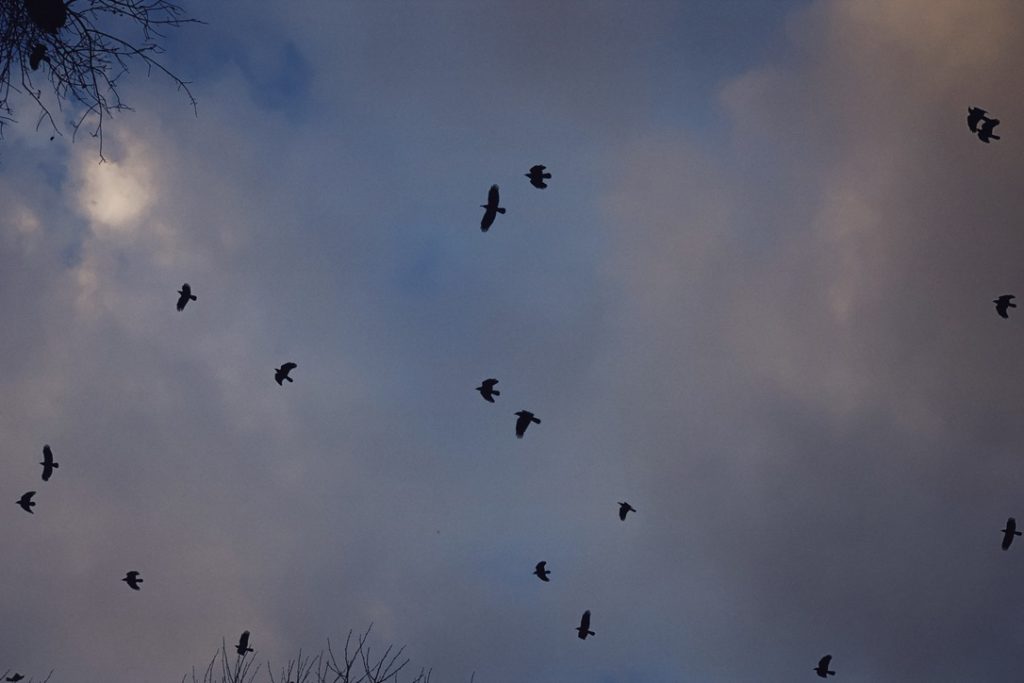
“Flying,” photo by Alma Alvarado Cabrera